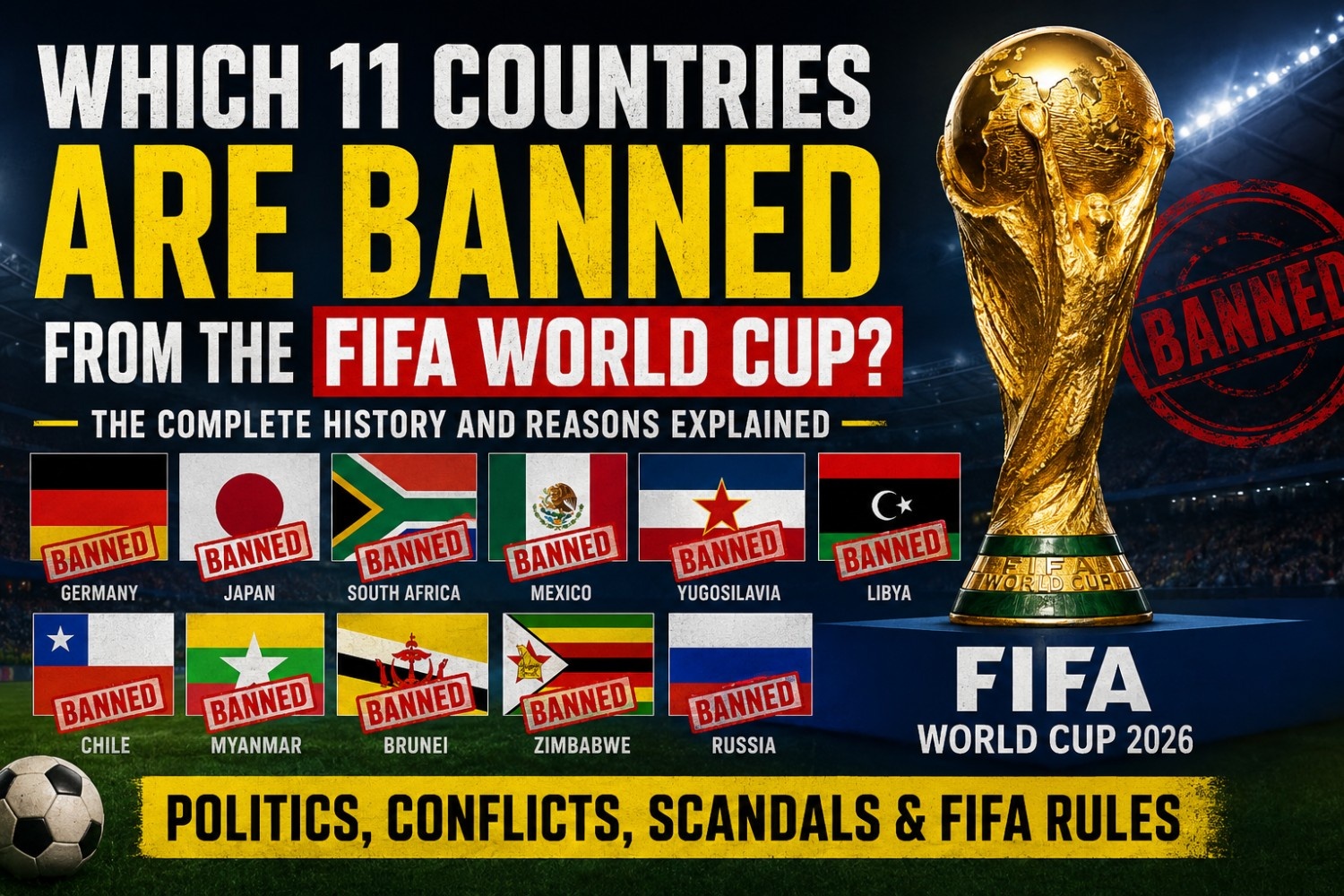
Discover the complete history of the 11 countries banned from the FIFA World Cup. Learn why FIFA suspended Germany, Japan, South Africa, Russia, Yugoslavia, Mexico, and others, plus why India has never qualified.
URL Slug: countries-banned-from-fifa-world-cup-history
Which 11 Countries Have Been Banned from the FIFA World Cup?
The FIFA World Cup is the most prestigious football tournament in the world. Every four years, national teams compete for football’s greatest prize, representing millions of passionate supporters. However, not every country gets the opportunity to participate. Throughout football history, FIFA has suspended, expelled, or banned several nations from World Cup competitions for reasons ranging from political conflicts to government interference and sporting misconduct.
The history of countries banned from the FIFA World Cup demonstrates that football is not isolated from world affairs. FIFA’s regulations require member associations to remain politically independent, maintain sporting integrity, and comply with international standards. When these principles are violated, FIFA can impose suspensions that prevent teams from participating in World Cup qualifiers or the tournament itself.
In this comprehensive guide, we explore the 11 countries that have faced FIFA World Cup bans, the reasons behind those decisions, their impact on international football, and why countries like India have never qualified despite having one of the world’s largest populations.
Why Does FIFA Ban Countries?
FIFA governs football across more than 200 member associations. To protect the sport, FIFA enforces strict regulations covering governance, fair competition, and political neutrality.
Countries generally face FIFA World Cup bans for three major reasons:
1. Political Conflicts
Wars, international sanctions, or geopolitical disputes can result in suspensions from FIFA competitions.
2. Government Interference
National governments are prohibited from controlling football federations. When governments interfere in elections, administration, or management, FIFA may suspend the association.
3. Sporting Misconduct
Match manipulation, player eligibility fraud, unpaid financial obligations, or refusal to play scheduled matches can also result in disciplinary action.
Complete List of the 11 Countries Banned from the FIFA World Cup
| Country | World Cup Affected | Reason |
|---|---|---|
| Germany | 1950 | Post-World War II sanctions |
| Japan | 1950 | Post-World War II sanctions |
| South Africa | 1970–1990 | Apartheid policies |
| Mexico | 1990 | Cachirules age-fraud scandal |
| Yugoslavia | 1994 | United Nations sanctions |
| Libya | 1994 | International sanctions |
| Chile | 1994 | Roberto Rojas scandal |
| Myanmar | 2006 | Refused to play qualifier |
| Brunei | 2014 | Government interference |
| Zimbabwe | 2018 | Financial misconduct |
| Russia | 2022 & 2026 | Suspension following the invasion of Ukraine |
1. Germany – Banned from the 1950 FIFA World Cup
Germany’s absence from the 1950 FIFA World Cup resulted from the aftermath of World War II. Following the war, Germany faced widespread international sanctions that extended into global sporting events.
FIFA excluded Germany from participating while the country underwent political reconstruction.
Ironically, just four years later Germany returned and famously won the 1954 FIFA World Cup, producing one of football’s greatest upsets known as the “Miracle of Bern.”
2. Japan – Excluded from the 1950 FIFA World Cup
Like Germany, Japan faced exclusion after World War II.
International sporting organizations temporarily suspended Japanese participation due to geopolitical consequences following the war.
Japan later rebuilt its football system and has since become one of Asia’s strongest football nations, regularly qualifying for FIFA World Cups.
3. South Africa – Banned Because of Apartheid
Perhaps the longest FIFA suspension in history involved South Africa.
Between 1970 and 1990, South Africa remained excluded because of its Apartheid policy, which legally enforced racial segregation.
FIFA determined that racial discrimination violated its principles of equality and fair competition.
Following the dismantling of Apartheid, South Africa was reinstated and later hosted the historic 2010 FIFA World Cup, becoming the first African nation to organize the tournament.
4. Mexico – The Cachirules Scandal
Mexico missed the 1990 FIFA World Cup after one of football’s most infamous age-fraud scandals.
The Mexican Football Federation fielded over-age players in a youth championship.
The incident became known as the Cachirules Scandal.
As punishment, FIFA suspended all Mexican national teams from international competitions, including qualification for Italia 1990.
Mexico eventually recovered and has qualified for every World Cup since 1994.
5. Yugoslavia – Banned from the 1994 World Cup
During the Balkan Wars, the United Nations imposed sanctions against Yugoslavia.
FIFA complied with these international sanctions by excluding Yugoslavia from World Cup competition.
Many talented players lost the opportunity to compete during what should have been the peak years of their careers.
The breakup of Yugoslavia later produced several independent football nations, including Croatia, Serbia, Slovenia, Bosnia and Herzegovina, Montenegro, North Macedonia, and Kosovo.
6. Libya – Prevented from Participating
Libya also missed qualification during the 1994 World Cup cycle.
International sanctions severely restricted the country’s international travel and sporting participation.
Although Libya was not permanently expelled from FIFA, the sanctions effectively prevented participation in the qualification process.
7. Chile – The Roberto Rojas Incident
Chile suffered one of football’s most dramatic disciplinary punishments.
During a World Cup qualifier against Brazil in 1989, goalkeeper Roberto Rojas collapsed after claiming he had been struck by a flare from the crowd.
Investigations later revealed that Rojas had secretly used a hidden razor blade to cut himself.
The deception shocked world football.
Consequences included:
- Chile was banned from the 1994 FIFA World Cup qualification.
- Roberto Rojas received a lifetime ban (later lifted years afterward).
- Chilean football suffered lasting reputational damage.
The “Maracanã Incident” remains one of FIFA’s most famous integrity cases.
8. Myanmar – Refusal to Play
Myanmar received a ban related to the 2006 FIFA World Cup qualifiers.
The national team refused to participate in a scheduled qualifying match.
FIFA considers refusal to play a serious breach of competition regulations.
As punishment, Myanmar was excluded from the next qualification cycle before eventually being readmitted.
9. Brunei – Government Interference
Government interference is among FIFA’s strictest violations.
Brunei’s football association experienced administrative intervention from authorities.
FIFA responded with suspension because member associations must remain independent.
Following governance reforms, Brunei regained FIFA membership and resumed international competition.
10. Zimbabwe – Financial Violations
Zimbabwe’s suspension stemmed from disciplinary issues involving unpaid financial obligations to a former national team coach.
FIFA requires member associations to honor contractual commitments.
Failure to comply resulted in suspension from international competitions until the dispute was resolved.
11. Russia – Suspended from FIFA Competitions
Russia represents the most recent and widely discussed FIFA suspension.
Following Russia’s invasion of Ukraine in 2022, FIFA and UEFA suspended Russian national teams and clubs from international competitions.
The suspension prevented Russia from participating in:
- 2022 FIFA World Cup playoffs
- UEFA competitions
- 2026 FIFA World Cup qualification process
The decision remains one of the most significant geopolitical actions ever taken by football’s governing bodies.
Countries That Faced Temporary FIFA Suspensions
Not every suspension becomes a long-term World Cup ban.
Several countries have experienced temporary FIFA suspensions before returning to competition.
Pakistan
Pakistan’s football federation has faced multiple suspensions due to government intervention and administrative disputes.
After governance reforms, FIFA lifted the suspension.
Congo-Brazzaville
The Congolese federation experienced temporary suspension during qualification because of governance issues.
The ban was eventually removed after FIFA requirements were met.
Common Reasons Behind FIFA Suspensions
Looking across history, most bans fall into several categories.
Political sanctions
International conflicts often influence sporting participation.
Human rights concerns
South Africa’s Apartheid era remains the clearest example.
Match integrity
Fraud, cheating, or manipulation can trigger severe penalties.
Administrative independence
Football associations must operate without political interference.
Financial responsibility
Failure to honor legal obligations may also result in suspension.
Does FIFA Ban Individual Players Too?
Yes.
Apart from national associations, FIFA regularly suspends players, coaches, referees, and officials for:
- Doping
- Match-fixing
- Corruption
- Racism
- Violence
- Breaches of FIFA disciplinary regulations
These punishments are separate from country-wide suspensions.
Why India Has Never Qualified for the FIFA World Cup
India has never been banned from the FIFA World Cup.
Instead, the country has struggled to qualify through sporting performance.
One of football’s biggest myths claims India withdrew from the 1950 FIFA World Cup because FIFA prohibited players from competing barefoot.
Modern historical research indicates that the reasons were more complex.
The major factors included:
- Financial constraints
- Long travel costs
- Greater priority given to the Olympic Games
- Limited preparation
- Administrative challenges
The barefoot story has become popular folklore but is no longer considered the primary explanation.
Current Challenges Facing Indian Football
Although football popularity continues to grow, India still faces several structural challenges.
Limited Grassroots Development
Many regions lack organized youth academies and coaching infrastructure.
Competitive Domestic Structure
The Indian Super League has improved professional football, but the broader football pyramid is still developing.
International Experience
Indian players receive fewer opportunities to compete against elite football nations.
FIFA Ranking
India remains outside the world’s leading football nations, making qualification extremely difficult through the Asian Football Confederation (AFC).
Could More Countries Be Banned in the Future?
Yes.
FIFA has repeatedly shown that it is willing to suspend member associations when rules are violated.
Potential reasons include:
- Government interference
- Armed conflicts
- Financial misconduct
- Electoral irregularities
- Corruption
- Match manipulation
However, FIFA generally prefers corrective measures before imposing long-term suspensions.
Frequently Asked Questions (FAQs)
Which country is currently banned from the FIFA World Cup?
Russia remains suspended from FIFA competitions following the 2022 invasion of Ukraine, preventing participation in recent World Cup qualification cycles.
Why was South Africa banned?
South Africa was expelled because of its Apartheid policy, which violated FIFA’s anti-discrimination principles.
Was India ever banned from the FIFA World Cup?
No. India has never been banned. The country has simply not qualified for the tournament through the qualification process.
Why was Mexico banned in 1990?
Mexico fielded over-age players in a youth competition, leading to the Cachirules scandal and suspension from the 1990 World Cup.
Why did Chile miss the 1994 World Cup?
Chile was punished after goalkeeper Roberto Rojas deliberately faked an injury during a World Cup qualifier against Brazil.
Final Thoughts
The history of countries banned from the FIFA World Cup reveals that football is influenced not only by performances on the pitch but also by politics, governance, ethics, and international law. From Germany and Japan’s post-war exclusion to South Africa’s Apartheid-era expulsion and Russia’s modern suspension, FIFA has repeatedly acted when its regulations or broader international circumstances demanded intervention.
At the same time, many suspensions have proven temporary. Nations such as Pakistan, Congo-Brazzaville, Brunei, and Zimbabwe eventually returned after addressing FIFA’s concerns. This demonstrates that FIFA’s objective is generally to restore compliance rather than permanently exclude countries.
For football fans, these cases serve as reminders that the FIFA World Cup is about more than sporting excellence. It is also a global event built on principles of fair play, independence, equality, and integrity. As football continues to evolve, FIFA will likely maintain its strict approach to protecting the credibility of the world’s biggest sporting tournament.