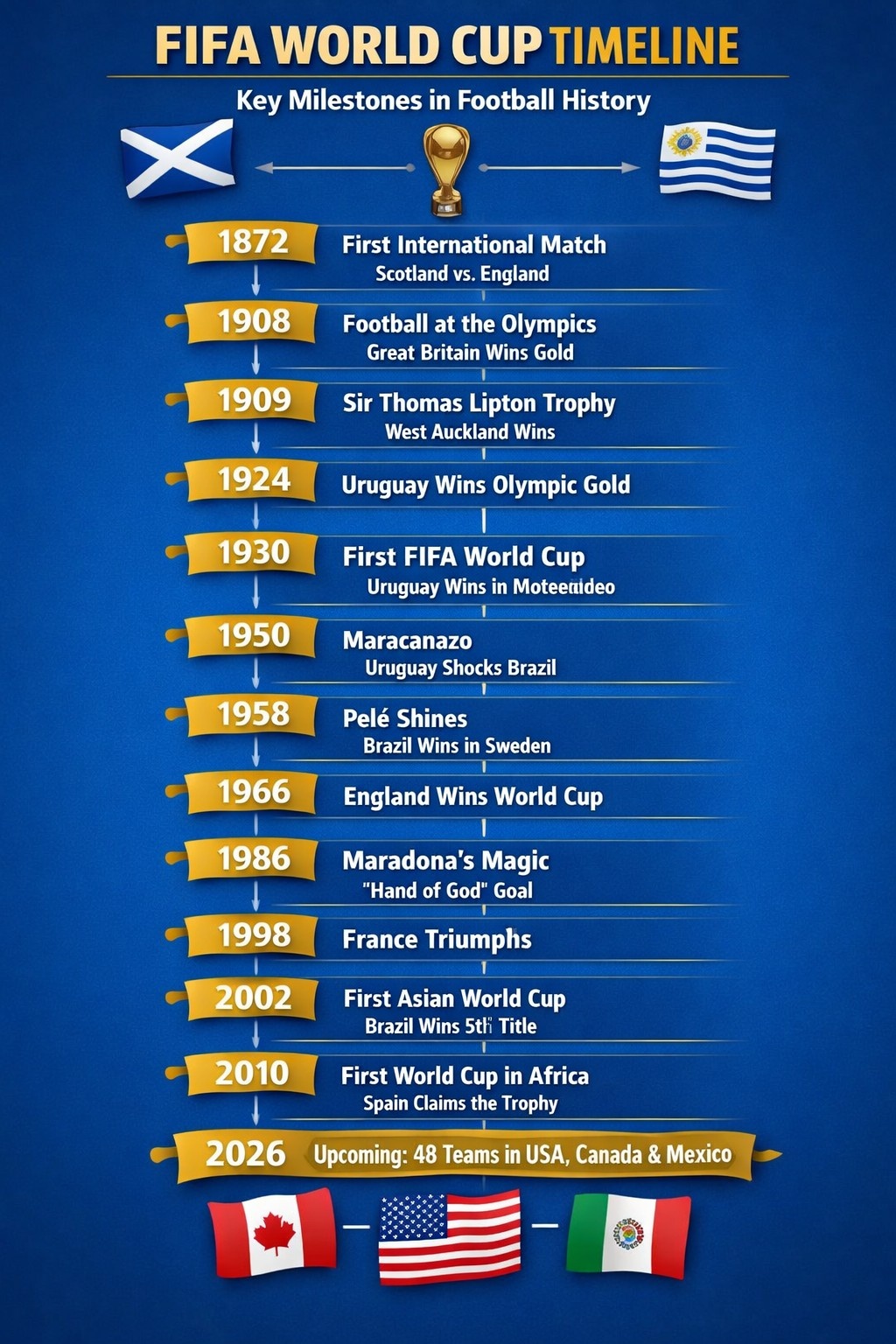
The FIFA World Cup is the most prestigious football tournament in the world, watched by billions and celebrated across continents. But its roots stretch back far before the first official World Cup in 1930. To understand how this global spectacle came to be, we need to trace the journey from the earliest international matches in the 19th century, through Olympic experiments, and finally to FIFA’s creation of a professional world championship.
This article explores the origins, milestones, and evolution of the World Cup, highlighting the fascinating story of how football became the planet’s most beloved sport.
🏴 Early International Football (1872–1904)
- First International Match (1872): Scotland vs. England in Glasgow marked the dawn of international football.
- British Home Championship (1884): The first regular international tournament, contested by England, Scotland, Wales, and Ireland.
- Olympic Demonstrations (1900 & 1904): Football appeared at the Paris and St. Louis Olympics as a demonstration sport, later retroactively recognized as official events.
Football’s popularity was spreading rapidly, but there was no unified global competition yet.
🏛 The Birth of FIFA and Early Attempts (1904–1914)
- FIFA Founded (1904): Established in Paris to govern international football.
- First Attempt (1906, Switzerland): FIFA tried to organize a non‑Olympic international tournament, but it was deemed unsuccessful.
- Olympics 1908 & 1912: Football became an official Olympic sport, but restricted to amateurs. Great Britain (represented by England’s amateur team) won both tournaments.
This era showed football’s potential but also highlighted the tension between amateurism and professionalism.
🏆 The Sir Thomas Lipton Trophy (1909 & 1911)
- Organized in Turin by Sir Thomas Lipton.
- Featured professional club sides from Italy, Germany, and Switzerland.
- England’s FA refused to participate, so West Auckland FC, an amateur team from County Durham, represented England.
- West Auckland won in 1909 and defended their title in 1911.
Often called the “First World Cup,” this tournament demonstrated the appetite for international club competition.
🥇 FIFA and the Olympics (1914–1928)
- 1914 Agreement: FIFA recognized the Olympic football tournament as the “world championship for amateurs.”
- 1920 Antwerp Olympics: First intercontinental competition, with Egypt joining 13 European teams. Belgium won.
- 1924 Paris Olympics: Uruguay stunned the world, defeating European teams with flair and skill.
- 1928 Amsterdam Olympics: Uruguay triumphed again, cementing their dominance.
These victories were crucial: Uruguay’s success marked the beginning of FIFA’s professional era. That’s why Uruguay proudly wears four stars on their crest—two for Olympic triumphs and two for World Cup victories.
🌟 The First FIFA World Cup (1930, Uruguay)
- FIFA decided to create its own professional world championship.
- Uruguay, celebrating its centenary of independence, hosted the inaugural tournament.
- 13 teams participated (7 from South America, 4 from Europe, 2 from North America).
- Uruguay defeated Argentina 4–2 in the final, becoming the first World Cup champions.
This was the birth of the modern World Cup, a tournament that would grow into the most watched sporting event on Earth.
📈 Expansion and Globalization (1934–1970)
- 1934 Italy: First World Cup in Europe, with 16 teams. Italy won.
- 1938 France: Italy defended their title.
- 1950 Brazil: After WWII, the World Cup returned. Uruguay shocked Brazil in the famous Maracanazo.
- 1954 Switzerland: West Germany won, defeating Hungary’s “Mighty Magyars.”
- 1958 Sweden: Brazil introduced Pelé, beginning their dominance.
- 1966 England: England won their only World Cup, defeating West Germany at Wembley.
- 1970 Mexico: Brazil, led by Pelé, won their third title, earning the Jules Rimet Trophy permanently.
🌍 Modern Era and Commercial Growth (1974–1998)
- 1974 West Germany: Introduction of the new FIFA World Cup Trophy.
- 1978 Argentina: Argentina won at home amid political controversy.
- 1982 Spain: Expanded to 24 teams. Italy triumphed.
- 1986 Mexico: Diego Maradona’s “Hand of God” and “Goal of the Century” defined Argentina’s victory.
- 1990 Italy: West Germany won their third title.
- 1994 USA: Brazil won their fourth title; the tournament boosted football’s popularity in America.
- 1998 France: Expanded to 32 teams. France, led by Zidane, won their first title.
⚡ The 21st Century (2002–2018)
- 2002 Korea/Japan: First co‑hosted World Cup. Brazil won their fifth title.
- 2006 Germany: Italy won their fourth title.
- 2010 South Africa: First World Cup in Africa. Spain won their first title.
- 2014 Brazil: Germany defeated Argentina; Brazil suffered a shocking 7–1 loss to Germany.
- 2018 Russia: France won their second title, defeating Croatia.
🌐 The 2026 FIFA World Cup: A New Era
- Hosted across Canada, Mexico, and the USA.
- Expanded to 48 teams, making it the largest World Cup ever.
- More matches, more opportunities, and more global representation.
This expansion reflects football’s universal appeal and FIFA’s ambition to grow the game worldwide.
The FIFA World Cup’s history is a story of ambition, innovation, and passion. From Scotland vs. England in 1872 to the mega‑tournament of 2026, football has grown into a truly global language. Each era brought new champions, unforgettable matches, and cultural milestones that shaped the sport.
The World Cup is more than just a competition—it is a celebration of humanity’s love for the beautiful game.