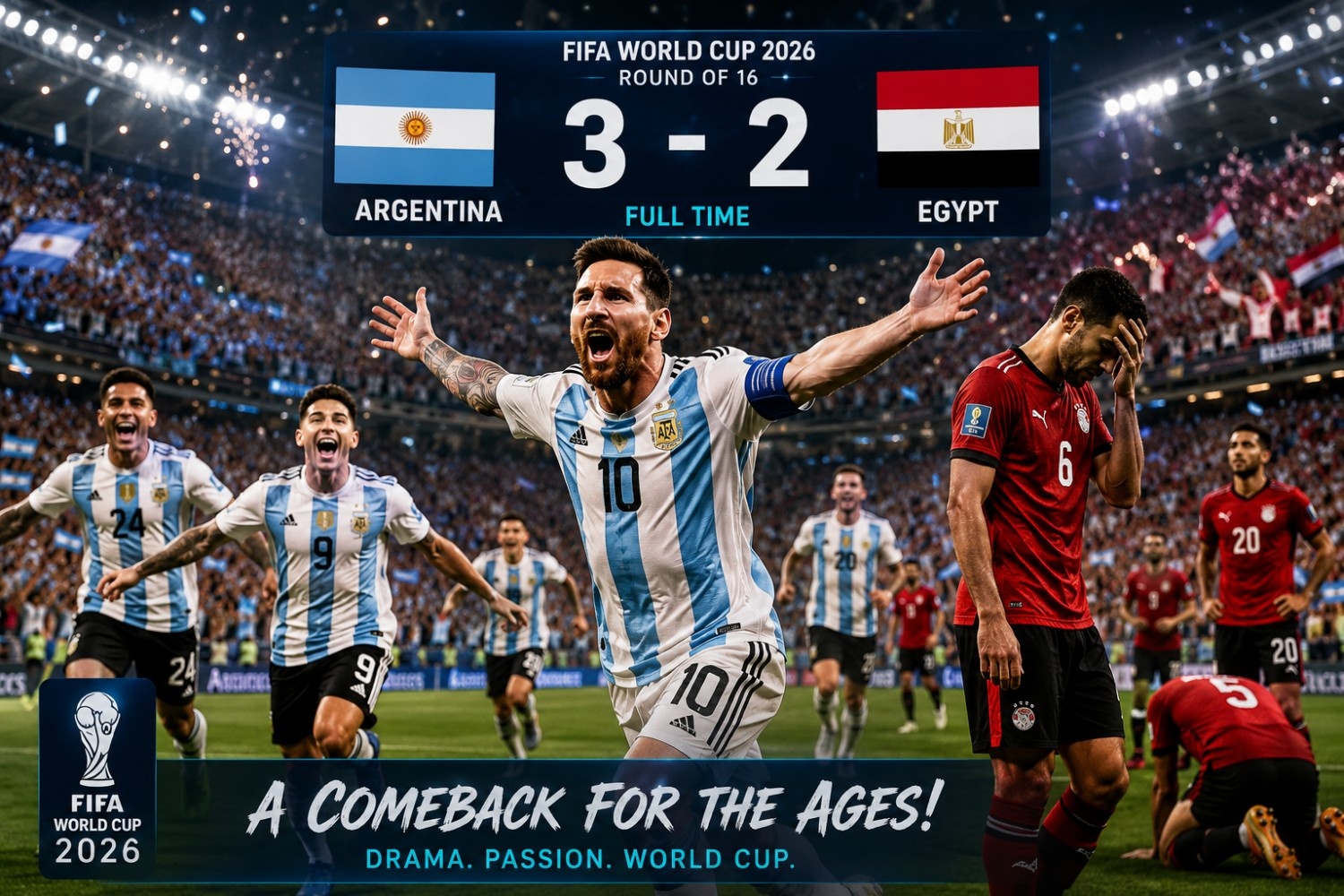
Argentina produced a remarkable 3-2 comeback victory over Egypt in the FIFA World Cup 2026 Round of 16. Discover the complete match analysis, Lionel Messi’s influence, VAR controversy, tactical breakdown, player performances, and what lies ahead for the defending champions.
fifa-world-cup-2026-argentina-vs-egypt-var-controversy-messi-comeback
FIFA World Cup 2026: Argentina Survive Egypt’s Biggest Challenge Yet
The FIFA World Cup 2026 has already delivered unforgettable drama, but few matches have matched the intensity of Argentina’s thrilling 3-2 victory over Egypt in the Round of 16. For much of the contest, Egypt appeared destined to produce one of the tournament’s greatest upsets. Instead, Lionel Messi inspired another memorable comeback as Argentina overturned a two-goal deficit to book their place in the quarter-finals.
Beyond the spectacular football, the match generated worldwide discussion because of several controversial refereeing decisions. A disallowed Egyptian goal, penalty appeals, and multiple VAR reviews became talking points across the football community. While Argentina celebrated an extraordinary escape, many Egyptian supporters left feeling frustrated by decisions they believed influenced the outcome.
Regardless of differing opinions, the encounter demonstrated exactly why the FIFA World Cup remains football’s greatest stage. It featured tactical battles, emotional swings, individual brilliance, and moments that will be remembered long after the tournament concludes.
Match Overview
Competition: FIFA World Cup 2026
Stage: Round of 16
Result: Argentina 3–2 Egypt
Venue: FIFA World Cup 2026 Knockout Stage
Winner: Argentina
Qualification: Argentina advanced to the quarter-finals.
A Dream Start for Egypt
Before kickoff, Argentina entered the match as clear favourites thanks to their experience, attacking quality, and the leadership of Lionel Messi. Egypt, however, arrived with confidence after an impressive group-stage campaign built on defensive organization, disciplined pressing, and quick transitions.
From the opening whistle, Egypt showed no fear. Instead of sitting deep, they pressed aggressively and disrupted Argentina’s passing rhythm. Their midfield closed down space effectively, forcing Argentina into misplaced passes and preventing Messi from finding dangerous positions between the lines.
The Egyptian defenders also remained compact, limiting Argentina’s wide attacks and forcing crosses into crowded areas. Every successful tackle increased Egypt’s confidence while unsettling the South American giants.
As the first half progressed, Egypt’s tactical discipline began to create genuine attacking opportunities.
Egypt Punish Argentina
Egypt’s breakthrough arrived after sustained pressure and intelligent movement in transition. Winning possession in midfield, they quickly moved the ball forward, exploiting the spaces left behind Argentina’s advancing full-backs.
A well-worked attacking move resulted in Egypt taking a deserved lead, sending their supporters into celebration.
Instead of protecting the advantage immediately, Egypt continued to attack with confidence. Their midfield repeatedly won second balls, while their forwards stretched Argentina’s defensive line with clever runs.
Argentina, usually composed under pressure, looked unusually vulnerable. Passes lacked precision, the pressing became disjointed, and several attacking moves ended before reaching the penalty area.
At this stage, Egypt appeared to be controlling both the tempo and the momentum of one of the biggest knockout matches of the FIFA World Cup 2026.
Argentina Search for Answers
Trailing in a knockout match is never comfortable, even for one of football’s most successful nations. Argentina needed a response.
Their coaching staff encouraged quicker ball circulation and greater width in attack. The midfield attempted to move possession faster to stretch Egypt’s disciplined defensive shape.
Messi gradually began dropping deeper into midfield to collect possession, allowing younger attackers to make runs beyond the Egyptian defence.
Although Argentina enjoyed more possession, Egypt remained compact and continued to frustrate every attempt to build sustained pressure.
The defending champions found themselves facing one of their toughest tests of the tournament.
Tactical Battle: Egypt’s Defensive Masterclass
One of the most fascinating aspects of the match was Egypt’s tactical discipline.
Their game plan revolved around several key principles:
- Maintaining a compact defensive block.
- Pressing aggressively in midfield.
- Winning second balls.
- Transitioning quickly after regaining possession.
- Limiting Messi’s space between midfield and defence.
- Remaining organized during Argentina’s sustained attacks.
For long periods, this strategy worked brilliantly.
Argentina struggled to create clear-cut chances because Egypt’s midfield consistently blocked passing lanes into dangerous areas.
Whenever Messi received possession, two or even three Egyptian players immediately closed him down.
The defensive organization highlighted the significant progress Egypt has made in recent years, proving they can compete with football’s elite on the biggest international stage.
The Match Turns: VAR Enters the Spotlight
As the second half unfolded, one of the game’s defining moments arrived.
Egypt believed they had doubled their advantage after finishing another impressive attacking move. However, following a video review, the referee disallowed the goal because of an earlier foul during the same attacking phase.
The decision immediately became one of the biggest talking points of the FIFA World Cup 2026 knockout stage.
Understanding this moment requires an explanation of how the Video Assistant Referee (VAR) system operates.
According to the Laws of the Game, if an attacking team commits a foul during the attacking phase that directly leads to a goal, the referee may cancel the goal after reviewing the incident. The review is not based solely on where the foul occurred but on whether it formed part of the same continuous attacking move.
While the law allows such intervention, debates often arise about whether the attacking phase should still be considered active after several seconds or multiple passages of play. That grey area fuels many discussions among players, coaches, and supporters whenever similar incidents occur.
This incident reignited worldwide debate over how consistently VAR is applied in high-pressure knockout matches.
Lionel Messi’s Calm Leadership
Even while Argentina trailed, Lionel Messi displayed the qualities that have defined his legendary career.
Rather than forcing difficult passes or rushing attacks, he focused on controlling possession, encouraging teammates, and identifying spaces that gradually began to appear as Egypt defended deeper.
Messi’s movement became increasingly intelligent as the match progressed. By drifting into different positions, he pulled defenders away from their shape and created opportunities for teammates to exploit.
His composure also helped prevent Argentina from becoming frustrated.
Instead of panicking, Argentina slowly rebuilt their confidence through controlled possession and patient attacking play.
That leadership would become increasingly important as the match entered its decisive final stages.
Why This Match Matters in FIFA World Cup 2026
Every World Cup produces matches that define the tournament. Argentina versus Egypt has already become one of those unforgettable encounters.
It showcased:
- The unpredictability of knockout football.
- The growing strength of emerging football nations.
- The influence of tactical discipline.
- The importance of experienced leaders.
- The ongoing debate surrounding VAR decisions.
- The emotional intensity that makes the FIFA World Cup unique.
Regardless of opinion on the refereeing decisions, both teams delivered a performance worthy of the global audience watching the tournament.
As the final minutes approached, however, the momentum began to shift dramatically—and with Lionel Messi on the pitch, Argentina still believed a comeback was possible.
FIFA World Cup 2026: Argentina’s Stunning Comeback Changes the Story
Argentina Find Their Fighting Spirit
With time running out, Argentina knew they had to increase both the tempo and intensity of their attacks. The coaching staff made tactical adjustments, introducing fresh legs and encouraging the full-backs to push higher up the pitch. The midfield also began playing quicker vertical passes, reducing the time Egypt had to reorganize defensively.
This change transformed the rhythm of the match.
Instead of patiently circulating possession, Argentina attacked with greater urgency. Every forward pass carried purpose, while Messi constantly searched for pockets of space between Egypt’s midfield and defensive lines.
Egypt, who had worked tirelessly for more than an hour, began to feel the physical demands of defending against relentless pressure.
The Momentum Begins to Shift
Football is often described as a game of momentum, and this match proved exactly why.
As Argentina increased their pressure, Egypt found it increasingly difficult to maintain possession after winning the ball. Clearances returned quickly, forcing the Egyptian defenders into wave after wave of defensive action.
The crowd sensed the momentum changing.
Every successful Argentine attack increased confidence, while every defensive block demanded even more energy from Egypt.
The psychological balance of the match had started to tilt.
Argentina Pull One Goal Back
Argentina finally found the breakthrough they desperately needed during the closing stages of normal time.
A well-constructed attacking move created space inside the penalty area, allowing Argentina to reduce the deficit. The goal completely changed the atmosphere of the contest.
For the first time in the match, Egypt looked uncertain.
Instead of controlling possession and launching dangerous counter-attacks, they were now forced almost entirely into defensive positions.
Argentina believed the comeback was possible.
Lionel Messi Delivers When It Matters Most
The defining moment arrived only a few minutes later.
Receiving the ball in a dangerous position, Lionel Messi once again demonstrated why he remains one of football’s greatest players. Showing remarkable composure under immense pressure, he produced a superb finish to bring Argentina level.
It was another iconic World Cup moment in an extraordinary international career.
Throughout football history, the greatest players have consistently delivered during the biggest occasions. Messi’s equaliser perfectly reflected that reputation.
Beyond the goal itself, his leadership throughout the comeback inspired the entire Argentine team to continue attacking instead of settling for extra time.
Egypt Continue to Fight
Despite surrendering their two-goal advantage, Egypt refused to give up.
They continued to press whenever opportunities arose and looked dangerous whenever they managed to break forward.
Their resilience highlighted the remarkable progress of Egyptian football. Facing one of the world’s strongest teams on football’s biggest stage, they competed with courage, discipline, and determination until the final whistle.
Even after Argentina equalised, Egypt remained capable of producing another decisive attack.
The Decisive Winning Goal
As stoppage time approached, both teams searched for the winning goal.
Argentina launched another quick attack, moving the ball with speed and precision through midfield. Excellent movement inside the final third created the opening that allowed the decisive finish.
The winning goal completed one of the most dramatic comebacks of the FIFA World Cup 2026.
Players, coaches, and supporters celebrated wildly, knowing how close Argentina had come to elimination.
For Egypt, the final whistle brought heartbreak after producing one of their finest performances of the tournament.
Tactical Changes That Changed the Match
Several tactical adjustments played a major role in Argentina’s comeback.
1. Greater Width
Argentina stretched Egypt’s defensive shape by pushing their wide players and full-backs much higher, creating additional crossing and passing opportunities.
2. Faster Ball Movement
The midfield reduced unnecessary touches and moved the ball more quickly between the lines, preventing Egypt from resetting their defensive block.
3. Messi’s Free Role
Rather than remaining in one attacking position, Messi drifted across the pitch, making it extremely difficult for defenders to mark him consistently.
4. High Pressing
Argentina pressed aggressively after losing possession, recovering the ball much earlier and keeping Egypt under constant pressure.
5. Fresh Substitutions
The substitutes added energy during the closing stages, helping Argentina maintain attacking intensity when Egypt began to tire physically.
Egypt’s Performance Deserves Recognition
Although Egypt exited the tournament, their display earned widespread respect.
Several aspects of their performance stood out:
- Outstanding defensive organisation.
- Intelligent pressing throughout most of the match.
- Quick transitions from defence to attack.
- Strong teamwork.
- Excellent tactical discipline.
- Belief against one of football’s traditional giants.
Their campaign demonstrated that Egypt can compete with elite international teams and will likely remain a serious contender in future major tournaments.
VAR and Refereeing Remain Talking Points
One of the biggest discussions after the match centred on the use of Video Assistant Referee (VAR).
Supporters and analysts debated multiple incidents that occurred throughout the contest. While some believed the officials correctly applied the Laws of the Game, others questioned the consistency of those decisions.
VAR continues to improve the accuracy of many important decisions, but football remains a sport where interpretation often plays a significant role.
As a result, controversial moments remain part of the game, especially during high-pressure knockout matches where every decision can influence the outcome.
Match Statistics
Final Score
Argentina 3–2 Egypt
Possession
Argentina controlled the majority of possession, particularly during the second half as they searched for goals.
Shots
Argentina created more attempts overall, while Egypt made excellent use of their counter-attacking opportunities.
Passing Accuracy
Argentina maintained a higher passing percentage, reflecting their control of possession during long periods.
Corners
Argentina won several corners as they increased pressure late in the game, while Egypt focused primarily on defending deep during the closing stages.
Player Ratings
Argentina
Lionel Messi – 9.5/10
A true captain’s performance. His leadership, movement, creativity, and crucial equalising goal completely changed the match.
Emiliano Martínez – 7.5/10
Made several important saves that kept Argentina within touching distance before the comeback.
Midfield Unit – 8.5/10
Improved significantly after halftime by increasing the speed of passing and controlling possession.
Egypt
Mohamed Salah – 8.5/10
Worked tirelessly throughout the match, creating opportunities and leading Egypt’s attacking efforts.
Defensive Line – 8/10
Excellent for much of the contest before the relentless Argentine pressure eventually broke through.
Midfield – 8/10
Disciplined, energetic, and instrumental in disrupting Argentina’s rhythm during the opening hour.
Messi’s Legacy Continues to Grow
Every FIFA World Cup adds another chapter to Lionel Messi’s remarkable international career.
While football is always a team sport, truly great players often shape defining moments. This comeback reinforced Messi’s reputation as a player capable of inspiring teammates under enormous pressure.
His influence extended far beyond scoring. His movement, decision-making, calmness, and leadership helped transform a seemingly impossible situation into one of Argentina’s greatest knockout victories in recent World Cup history.
FIFA World Cup 2026: Records, Quarter-final Preview, FAQs and Final Verdict
Records and Milestones from Argentina vs Egypt
Every memorable FIFA World Cup match leaves behind statistics that become part of football history, and Argentina’s dramatic victory over Egypt was no exception.
Some of the biggest milestones from this Round of 16 clash include:
- Argentina completed one of the most dramatic comeback victories of the FIFA World Cup 2026 knockout stage.
- Lionel Messi once again scored in a crucial knockout match, reinforcing his reputation as one of football’s greatest performers on the biggest stage.
- Egypt produced one of their strongest World Cup performances despite suffering elimination.
- Argentina reached another FIFA World Cup quarter-final, continuing their tradition of deep tournament runs.
- The match became one of the most talked-about fixtures of FIFA World Cup 2026 because of its dramatic finish and widespread debate surrounding VAR decisions.
More than the statistics, the game reminded football fans why knockout football is so captivating. A match can change completely within a matter of minutes.
What This Victory Means for Argentina
Argentina’s comeback represented much more than simply progressing to the next round.
Confidence Boost
Recovering from a two-goal deficit showed the team’s resilience and belief under pressure. Winning difficult matches often strengthens a squad mentally for the challenges ahead.
Leadership
Experienced players stepped forward when Argentina needed them most. Calm decision-making and teamwork proved decisive during the closing stages.
Tactical Flexibility
The coaching staff successfully adjusted the team’s approach during the second half, demonstrating the importance of adapting to different opponents in tournament football.
Momentum for the Quarter-finals
Teams that survive difficult knockout matches frequently carry extra confidence into the next round. Argentina will hope this dramatic victory becomes a turning point in their FIFA World Cup 2026 campaign.
Egypt Leave with Pride
Although the result ended Egypt’s World Cup journey, their performances throughout the tournament earned admiration from supporters around the world.
Several positives stand out:
A Fearless Approach
Egypt refused to be intimidated by one of football’s biggest nations. They attacked with confidence and defended with discipline.
Tactical Improvement
The team’s organisation, pressing, and transition play demonstrated significant progress on the international stage.
Valuable Experience
Competing in high-pressure knockout football provides invaluable experience for younger players, helping build a stronger foundation for future international tournaments.
A Bright Future
If Egypt continue developing talented players and maintaining tactical discipline, they have every reason to believe they can challenge the world’s best teams again.
Quarter-final Preview
Argentina’s dramatic escape sets up another exciting challenge in the FIFA World Cup 2026 quarter-finals.
Key areas to watch include:
- Can Argentina improve their defensive organisation after conceding two goals?
- Will Lionel Messi continue producing decisive moments?
- Can Argentina start matches with greater intensity instead of relying on late comebacks?
- Which young players will step up alongside the experienced stars?
Knockout football becomes increasingly demanding with each round, and Argentina will know that another slow start could prove costly against elite opposition.
Key Takeaways
The Argentina vs Egypt encounter highlighted several important lessons from FIFA World Cup 2026:
- Never underestimate the determination of emerging football nations.
- Tactical discipline can trouble even the tournament favourites.
- Momentum can change rapidly in knockout football.
- Leadership and composure remain invaluable during high-pressure moments.
- VAR continues to influence major matches and spark debate among players, coaches, analysts, and supporters.
- Small tactical adjustments can completely change the outcome of a match.
Above all, the match demonstrated why the FIFA World Cup remains the pinnacle of international football, where drama, passion, and unforgettable moments combine on the sport’s biggest stage.
Frequently Asked Questions (FAQ)
Who won the Argentina vs Egypt match in the FIFA World Cup 2026?
Argentina won the Round of 16 match 3–2 after staging a remarkable comeback from two goals down.
Why was the match so controversial?
The game featured several debated refereeing decisions, including a disallowed Egyptian goal after a VAR review and appeals for a penalty during the closing stages. These incidents generated significant discussion among fans and football analysts.
How important was Lionel Messi?
Messi played a crucial leadership role throughout the match. His movement, creativity, composure, and equalising goal helped inspire Argentina’s comeback.
What does this result mean for Argentina?
The victory sends Argentina into the FIFA World Cup 2026 quarter-finals and provides valuable momentum for the remainder of the tournament.
Can Egypt be proud of their tournament?
Yes. Egypt impressed with disciplined defending, organised teamwork, and fearless performances against top-level opposition. Their campaign showed encouraging progress and offers optimism for future international competitions.
Final Thoughts
The FIFA World Cup 2026 continues to deliver unforgettable football, and Argentina’s dramatic victory over Egypt will be remembered as one of the tournament’s defining matches.
For much of the game, Egypt looked capable of producing one of the greatest upsets in World Cup history. Their disciplined defending, intelligent tactics, and determined performances pushed Argentina to the brink of elimination.
However, football’s biggest stars often shine brightest in the biggest moments.
Argentina showed resilience, patience, and belief to recover from a difficult position. Their comeback reflected the mentality of champions, while Lionel Messi once again demonstrated why he remains one of the game’s greatest players.
At the same time, Egypt’s display earned widespread respect. Even in defeat, they proved they belong among the world’s strongest footballing nations and provided their supporters with plenty of reasons to look forward to the future.
As the tournament moves into the quarter-finals, the excitement continues to grow. If the remaining knockout matches produce the same level of drama, passion, and quality, the FIFA World Cup 2026 could be remembered as one of the greatest editions in football history.