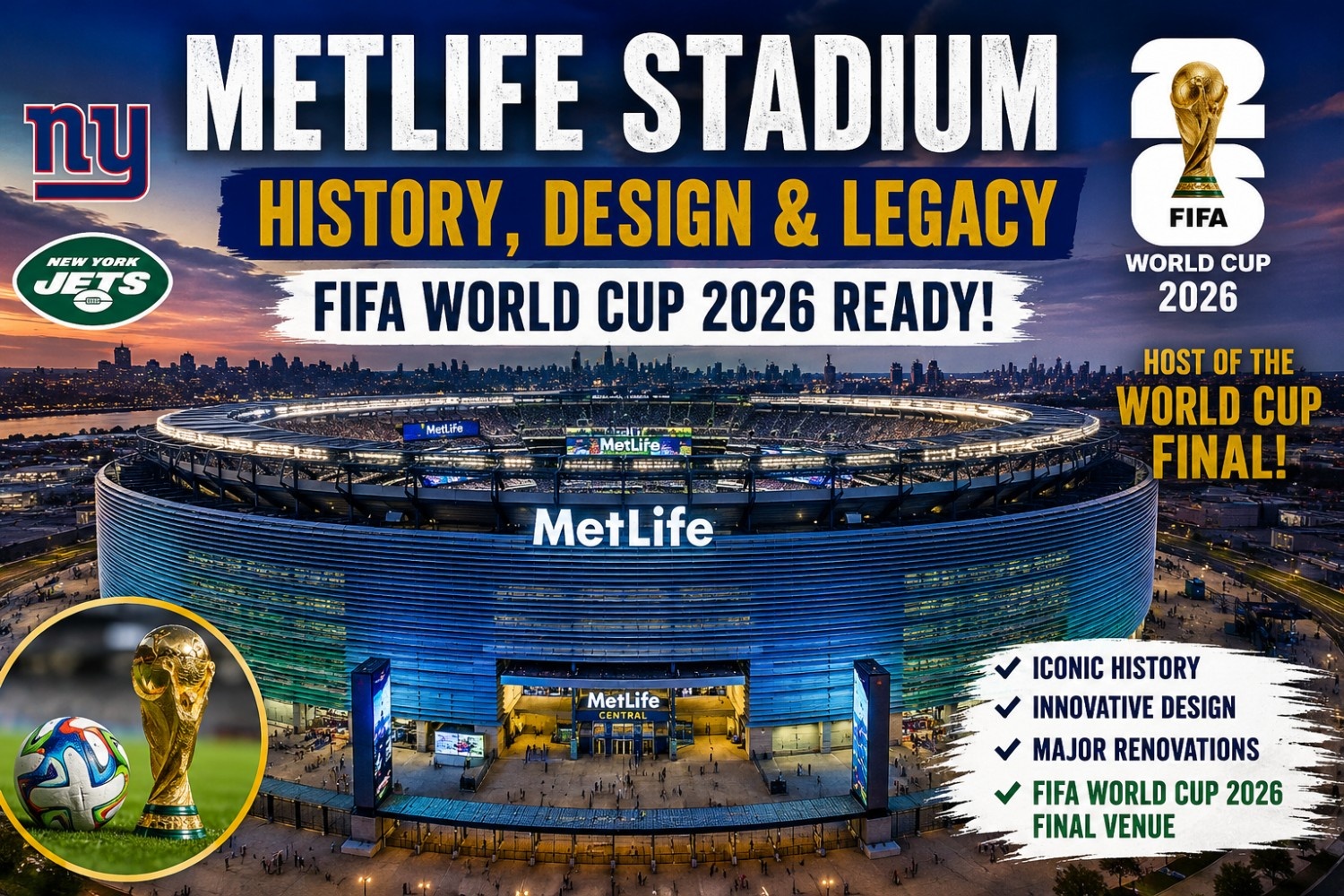
Discover the complete history of MetLife Stadium, its unique design, renovations, NFL legacy, and preparations for hosting the FIFA World Cup 2026 Final.
SEO URL Slug
metlife-stadium-history-design-fifa-world-cup-2026
MetLife Stadium is much more than the home of two NFL franchises. It is one of the most technologically advanced, versatile, and iconic sporting venues in the United States. Located in East Rutherford, New Jersey, just minutes from New York City, MetLife Stadium has become a global sports destination.
With a seating capacity exceeding 82,000 spectators, the stadium has hosted NFL games, international soccer matches, concerts by the world’s biggest artists, college football, and is preparing to host one of the biggest sporting events on the planet—the FIFA World Cup 2026 Final.
This article explores the complete history of MetLife Stadium, its revolutionary design, engineering innovations, renovations, sustainability initiatives, and why it has become one of the world’s premier sports venues.
Why Was MetLife Stadium Built?
By the early 2000s, Giants Stadium, opened in 1976, was beginning to show its age. Although it remained one of the NFL’s most recognizable venues, modern stadiums across the United States were offering improved fan experiences, luxury seating, advanced technology, and increased revenue opportunities.
Both the New York Giants and the New York Jets needed a new home.
Initially, the Jets planned to build the proposed West Side Stadium in Manhattan. The project was intended to serve multiple purposes:
- Home stadium for the Jets
- Main venue for New York City’s bid for the 2012 Olympic Games
- Major convention and entertainment facility
However, the project faced significant political and financial opposition and was eventually abandoned.
Following the collapse of the Manhattan proposal, the Giants and Jets reached an unprecedented agreement. Instead of building separate stadiums, they formed a joint partnership to create a world-class venue that both franchises would equally own and operate.
The result was MetLife Stadium, a project that would redefine modern stadium sharing.
A Stadium Designed for Two NFL Teams
One of the biggest architectural challenges was creating a stadium that could truly represent two completely different franchises.
The architects were asked to make the stadium neutral while allowing each team to maintain its own identity.
The design carefully blends two different architectural styles.
Giants’ Vision
The Giants preferred a traditional football atmosphere featuring:
- Exposed structural steel
- Stone-inspired architecture
- Classic NFL stadium appearance
Jets’ Vision
The Jets wanted something modern with:
- Glass features
- Metallic finishes
- Contemporary architecture
- Sleek visual aesthetics
The final design combines both visions beautifully.
Inspired by the skyscrapers of nearby Manhattan, the stadium uses vertical tower-like structures that create a modern yet timeless appearance.
Exterior Architecture
The stadium’s exterior is instantly recognizable.
Its lower façade is wrapped in limestone-style stonework, while the upper structure features:
- Aluminum louvers
- Large glass panels
- Dynamic LED lighting
One of its most distinctive features is the programmable lighting system.
Depending on which NFL team is playing, the entire stadium changes color:
- Blue for the Giants
- Green for the Jets
This innovative lighting concept was inspired by Germany’s famous Allianz Arena, another stadium known for changing colors based on the home team.
One Stadium, Two Home Fields
MetLife Stadium was specifically engineered to transform quickly between Giants and Jets home games.
Within hours, crews can replace:
- End zone graphics
- Stadium branding
- Team banners
- Digital signage
- Locker room branding
Even the midfield logo can be changed.
Originally, replaceable logos were installed at midfield. After injury concerns related to raised logo materials, the NFL logo replaced team logos for several seasons.
Beginning in 2023, both the Giants and Jets returned to using their own painted midfield logos during home games using water-soluble paint that can be removed quickly when needed.
World-Class Seating Experience
MetLife Stadium was built with fans in mind.
Unlike older stadiums that often blocked sightlines, every section was carefully engineered to provide clear views of the field.
One of its most impressive statistics is that front-row seats are only 46 feet from the sideline, making fans feel remarkably close to the action.
The seating bowl consists of:
| Section | Seats |
|---|---|
| Lower Bowl | 33,346 |
| Mid Bowl | 21,323 |
| Upper Bowl | 27,897 |
Overall capacity exceeds 82,500 spectators, making it the largest NFL stadium by seating capacity.
Premium amenities include:
- Over 10,000 club seats
- Approximately 218 luxury suites
- Spacious concourses
- Modern concessions
- Excellent accessibility
State-of-the-Art Technology
Technology plays a central role in the fan experience.
MetLife Stadium includes:
- Massive HD video boards
- LED entrance pylons
- High-definition digital displays
- Advanced stadium-wide communication systems
The famous “Great Wall” display stretches approximately 400 feet across one entrance and can rotate digital graphics depending on the event.
In 2025, the stadium underwent another significant technology upgrade.
Improvements included:
- New ultra-high-resolution LED video boards
- More than 1,000 new stadium speakers
- Enhanced sound quality
- Improved visual clarity throughout the venue
These upgrades ensure fans enjoy an immersive experience regardless of where they sit.
Locker Rooms Built for Flexibility
Because two NFL teams permanently share the venue, MetLife Stadium includes four complete locker rooms.
These include:
- Giants locker room
- Jets locker room
- Two visitor locker rooms
When the Giants and Jets play one another, each team uses its own locker room along with an adjacent visitor locker room for additional space.
This flexibility allows the stadium to efficiently host NFL games, international soccer matches, college football, and other sporting events.
Sustainability and Green Innovation
MetLife Stadium is also recognized for its environmental initiatives.
In 2012, a partnership with NRG Energy led to the installation of the innovative Solar Ring.
This system includes:
- 1,350 integrated solar panels
- 47 photovoltaic frames
- LED lighting system
- Approximately 350 kilowatts of electricity generation
The solar panels produce significantly more electricity than needed for the stadium’s lighting displays.
Any excess energy is used elsewhere in stadium operations or supplied back to the electrical grid.
The Solar Ring also serves as a visual attraction, illuminating the stadium in customized colors during concerts, sporting events, and special celebrations.
Preparing for FIFA World Cup 2026
Perhaps the most significant transformation in MetLife Stadium’s history has been its preparation for the FIFA World Cup 2026.
The stadium was selected to host:
- Multiple World Cup matches
- The FIFA World Cup 2026 Final
Hosting the world’s biggest football match required major renovations.
FIFA requires larger field dimensions than those typically used for NFL games.
Beginning in January 2024, construction crews started an ambitious renovation project.
The work occurred in two carefully planned phases to avoid disrupting NFL seasons.
Stadium Renovations for the World Cup
To meet FIFA’s standards while maintaining NFL functionality, engineers made substantial structural changes.
The renovations included:
- Demolition of four seating-bowl corners
- Installation of modular steel seating systems
- Mechanical upgrades
- Electrical improvements
- Audio-visual modernization
- Plumbing enhancements
The redesigned corners provide enough space for a regulation FIFA pitch while preserving the stadium’s seating capacity.
Additionally, approximately 1,740 permanent seats were replaced with a newly engineered seating configuration.
The result is a stadium capable of seamlessly transitioning between NFL football and international soccer.
Why MetLife Stadium Is Perfect for Global Events
Few stadiums worldwide offer the flexibility found at MetLife Stadium.
Its advantages include:
- Massive seating capacity
- Modern infrastructure
- Easy transportation access
- Proximity to New York City
- Cutting-edge technology
- Excellent media facilities
- Premium hospitality areas
These qualities make it ideal for:
- FIFA World Cup
- NFL games
- International soccer
- College football
- Major concerts
- Entertainment events
The venue has hosted some of the world’s biggest performers and continues attracting international sporting events.
Economic Impact
Hosting the FIFA World Cup 2026 is expected to generate billions of dollars in economic activity across the New York–New Jersey region.
Benefits include:
- Increased tourism
- Hotel bookings
- Restaurant revenue
- Retail spending
- Transportation growth
- Temporary employment
- International media exposure
Millions of football fans are expected to visit the area during the tournament, further cementing MetLife Stadium’s status as one of the world’s premier sporting venues.
The Future of MetLife Stadium
Even after the FIFA World Cup 2026, MetLife Stadium will remain one of the busiest stadiums in North America.
Its future includes:
- NFL seasons
- International soccer friendlies
- Major concerts
- College sporting events
- Special entertainment shows
- Potential future global tournaments
Continuous technological upgrades and infrastructure improvements ensure the stadium remains competitive with the newest venues worldwide.
Final Thoughts
MetLife Stadium represents the evolution of modern sports architecture. Born from the shared vision of two NFL franchises, it has grown into one of the most versatile and technologically advanced stadiums in the world.
Its innovative dual-team design, exceptional fan experience, sustainable features, and extensive renovations for the FIFA World Cup 2026 showcase how a stadium can successfully serve multiple purposes while maintaining world-class standards.
As it prepares to host the FIFA World Cup 2026 Final, MetLife Stadium is poised to welcome fans from every corner of the globe. Whether you’re an NFL supporter, a football enthusiast, or simply interested in remarkable engineering, MetLife Stadium stands as a symbol of innovation, collaboration, and sporting excellence.
Frequently Asked Questions (FAQs)
Q1. Where is MetLife Stadium located?
MetLife Stadium is located in East Rutherford, New Jersey, within the Meadowlands Sports Complex, just outside New York City.
Q2. What is the seating capacity of MetLife Stadium?
The stadium can accommodate more than 82,500 spectators, making it the largest NFL stadium by seating capacity.
Q3. Which NFL teams play at MetLife Stadium?
The stadium is home to both the New York Giants and the New York Jets.
Q4. Why is MetLife Stadium important for FIFA World Cup 2026?
MetLife Stadium will host several matches during the tournament, including the FIFA World Cup 2026 Final, following major renovations to meet FIFA standards.
Q5. Does MetLife Stadium have sustainable features?
Yes. The stadium includes a Solar Ring with 1,350 photovoltaic panels, energy-efficient LED lighting, and other environmentally friendly technologies.