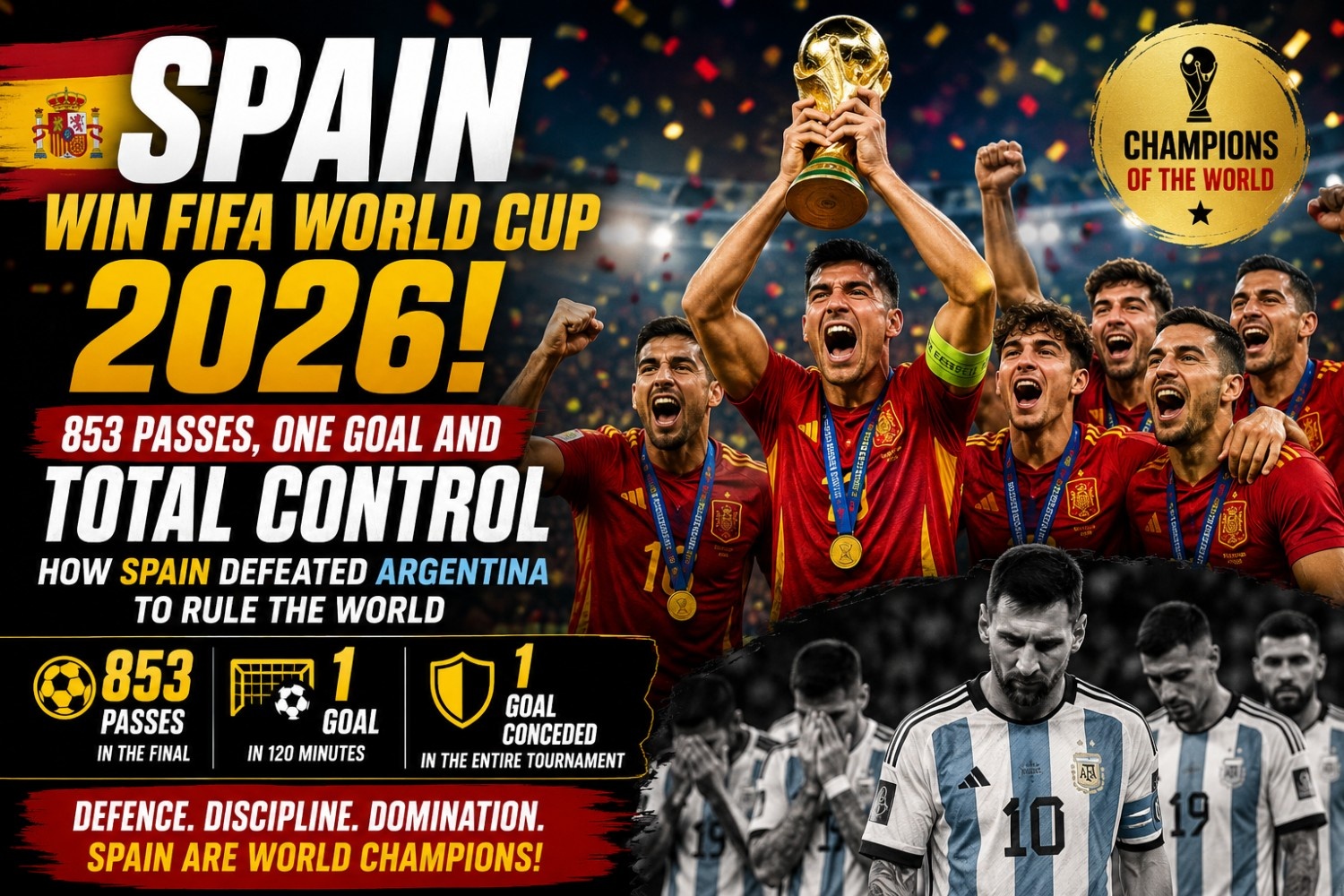

Spain defeated Argentina to win the FIFA World Cup 2026 with 853 passes, dominant possession, and a defensive masterclass that silenced Lionel Messi.
URL Slug
spain-win-fifa-world-cup-2026-853-passes-argentina-final-analysis
The Spain FIFA World Cup 2026 victory will be remembered as one of the greatest tactical performances in football history. Spain didn’t simply beat Argentina in the final—they completely controlled every aspect of the match. Their patient passing, disciplined defending, and intelligent positioning ensured Lionel Messi and Argentina struggled to create meaningful opportunities throughout the game. By the end of an intense 120 minutes, Spain had secured a historic 1-0 victory thanks to Ferran Torres’ extra-time winner, lifting their second FIFA World Cup trophy and confirming themselves as the best team of the tournament.
Spain entered the final as European champions and one of the strongest sides in international football. Under head coach Luis de la Fuente, they had developed into a team capable of dominating possession while remaining incredibly difficult to break down defensively. Throughout the FIFA World Cup 2026, Spain displayed consistency, tactical intelligence, and teamwork. Against Argentina, they produced arguably their finest performance of the tournament, controlling possession from the opening whistle until the final celebration.
The most remarkable statistic from the match was Spain’s incredible 853 completed passes. That number illustrates just how dominant they were throughout the final. Argentina rarely enjoyed long periods with the ball because Spain constantly recycled possession with calmness and precision. Every player was comfortable receiving the ball under pressure, and every movement was designed to create another passing option. Rather than forcing risky attacks, Spain patiently built every move from the back, waiting for the perfect opportunity to advance.
To appreciate the significance of this achievement, it is worth comparing it with Spain’s legendary 2010 World Cup-winning team. That side, featuring Xavi, Andrés Iniesta, Sergio Busquets, David Villa, and Carles Puyol, completed around 715 passes in the final against the Netherlands. The 2026 champions surpassed that remarkable total, proving that this new generation has successfully modernized Spain’s famous possession-based philosophy while maintaining its core principles.
From the opening minutes, it became obvious that Argentina would spend much of the evening chasing the ball. Lionel Scaloni knew Spain’s midfield could dominate possession, so his side focused on remaining compact rather than pressing aggressively. However, Spain’s technical quality made that strategy almost impossible to execute successfully. Whenever Argentina stepped forward to press, Spain calmly played around them with short, accurate passes. Whenever Argentina dropped deeper, Spain patiently moved the ball from one side of the pitch to the other until spaces eventually appeared.
Lionel Messi entered the final hoping to end his extraordinary World Cup career with another title, but Spain’s defensive organization left him isolated for long periods. Every time Messi received possession, multiple Spanish players quickly surrounded him, preventing him from turning or finding dangerous passing lanes. The Argentina captain still produced moments of brilliance, but they were too rare to change the outcome. Spain’s tactical discipline ensured that one of football’s greatest players never truly influenced the match.
A major reason for Spain’s complete control was the outstanding partnership between Rodri, Pau Cubarsí, and Aymeric Laporte. Together, they formed the foundation of Spain’s success throughout the FIFA World Cup 2026. These three players were not only responsible for defending but also for beginning almost every attacking move. They controlled possession deep inside Spain’s half, invited pressure, and then calmly played through Argentina’s defensive lines.
The numbers highlight just how influential they were. Rodri, Cubarsí, and Laporte combined for 359 touches, accounting for a huge percentage of Spain’s total involvement on the ball. Rodri repeatedly dropped between the central defenders to create numerical superiority during the build-up. Cubarsí, despite his young age, displayed remarkable composure against experienced attackers, while Laporte provided leadership and calmness whenever Argentina attempted to increase the tempo.
Rodri’s performances throughout the tournament earned him the prestigious Golden Ball Award as the best player of the FIFA World Cup 2026. Against Argentina, he produced another midfield masterclass. He rarely misplaced a pass, constantly intercepted attacks before they became dangerous, and dictated Spain’s rhythm from start to finish. Every important attack seemed to begin with Rodri calmly assessing the field before choosing the correct pass. His ability to slow the game when necessary or accelerate attacks at exactly the right moment demonstrated why many consider him the world’s finest defensive midfielder.
Young defender Pau Cubarsí also announced himself as one of football’s brightest stars during the tournament. Winning the Best Young Player Award, Cubarsí consistently showed maturity far beyond his years. In the final, his positioning was exceptional, allowing him to intercept dangerous passes before Argentina could create scoring opportunities. His confidence on the ball also enabled Spain to maintain possession even under intense pressure. Instead of clearing the ball aimlessly, Cubarsí always looked for intelligent passing options, helping Spain build attacks from the back with confidence.
Spain’s defensive record throughout the FIFA World Cup 2026 was nothing short of historic. Across the entire tournament, Spain conceded just one goal, setting one of the greatest defensive records in World Cup history. Their success was not built solely on outstanding defenders but on collective teamwork. Every player contributed defensively. The forwards initiated the press, the midfielders blocked passing lanes, and the defenders maintained perfect positioning. Goalkeeper Unai Simón rarely needed to produce spectacular saves because Spain consistently prevented opponents from creating clear-cut chances. Their defensive organization frustrated every team they faced, from the group stage to the final against Argentina.
Head coach Luis de la Fuente deserves enormous credit for creating a team that combined technical brilliance with tactical discipline. Unlike many international teams that rely on moments of individual brilliance, Spain operated as a complete unit. Every player understood their responsibilities whether attacking or defending. Their positional play allowed them to dominate possession without leaving dangerous spaces behind. Even when opponents attempted high pressing, Spain calmly played through the pressure using quick one-touch passing and intelligent movement. This tactical flexibility made them almost impossible to stop throughout the competition.
Although Spain controlled possession for most of the final, Argentina defended with determination and resilience. Emiliano Martínez produced several excellent saves to keep his team in the contest, while Argentina’s defenders blocked numerous dangerous crosses and shots. As the minutes passed, it appeared the match might be decided by a single moment of brilliance. Spain remained patient, refusing to abandon their possession-based philosophy even as the game entered extra time. Their confidence in the system eventually produced the decisive breakthrough.
The winning goal finally arrived in the 106th minute when Ferran Torres found space inside the penalty area and calmly finished past Emiliano Martínez. The goal sparked wild celebrations among Spanish players and supporters inside MetLife Stadium. It was a reward for more than one hundred minutes of relentless pressure and disciplined football. Rather than forcing attacks or becoming frustrated, Spain continued trusting their passing game until the perfect opportunity appeared. Ferran Torres’ finish became one of the most memorable moments in Spanish football history and secured the country’s second FIFA World Cup title.
For Lionel Messi, the defeat marked a heartbreaking conclusion to what many expect to be his final FIFA World Cup appearance. Having guided Argentina to World Cup glory in 2022, Messi dreamed of ending his remarkable international career with another championship. However, Spain’s exceptional defensive structure denied him the space and freedom he usually enjoys. Despite producing flashes of his extraordinary quality, Messi spent much of the evening surrounded by Spanish defenders who limited his influence. While the result was disappointing for Argentina, it does little to diminish Messi’s extraordinary legacy as one of the greatest footballers of all time.
One of the defining characteristics of this Spanish team was the perfect balance between experienced leaders and fearless young talents. Rodri, Aymeric Laporte, Dani Olmo, and Unai Simón provided experience and composure in crucial moments, while emerging stars such as Pau Cubarsí and Lamine Yamal brought energy, creativity, and confidence. Every player accepted their role within Luis de la Fuente’s tactical system, creating a squad built on unity rather than individual stardom. That collective mentality separated Spain from many other teams at the FIFA World Cup 2026.
The statistics from the final perfectly illustrate Spain’s complete dominance. They completed 853 passes, recorded over 1,091 touches, controlled possession for most of the match, and limited Argentina to very few dangerous opportunities. Rodri, Cubarsí, and Laporte alone accounted for 359 touches, highlighting how Spain’s defensive players controlled the rhythm of the game. Ferran Torres scored the decisive goal, while Rodri’s outstanding tournament performances earned him the Golden Ball Award. Pau Cubarsí was deservedly named Best Young Player, recognizing his incredible maturity and consistency throughout the competition.
Spain’s FIFA World Cup 2026 triumph also sends an important message about the evolution of modern football. Many experts believed possession football had become less effective against physically powerful and aggressive pressing teams. Spain proved otherwise. They demonstrated that intelligent movement, technical excellence, quick passing, and disciplined defending remain the foundation of championship-winning football. Rather than simply keeping possession for its own sake, Spain used the ball to control space, dictate tempo, and gradually wear opponents down. Their style combined the best elements of classic Spanish football with the athletic intensity required in today’s game.
Looking ahead, the future appears incredibly bright for Spanish football. Many of the stars who led the team to World Cup glory are still entering the prime years of their careers, while younger talents continue to develop at an impressive rate. Rodri remains the heartbeat of the midfield, Pau Cubarsí has already established himself among the world’s most promising defenders, and Spain’s talented attacking players provide endless creativity going forward. If this group continues to develop together, Spain could dominate international football for many years and challenge for future European Championship and World Cup titles.
In conclusion, the Spain FIFA World Cup 2026 victory over Argentina will be remembered as one of the finest tactical performances ever produced in a World Cup final. Completing 853 passes, conceding only one goal throughout the tournament, and controlling every important phase of the final demonstrated a level of footballing intelligence rarely seen on the biggest stage. Luis de la Fuente built a team that perfectly balanced defensive discipline, technical quality, patience, and attacking precision. Rodri controlled the midfield with remarkable authority, Pau Cubarsí emerged as one of football’s brightest young defenders, and Ferran Torres delivered the historic extra-time winner that secured Spain’s place in football history. More than simply winning the FIFA World Cup 2026, Spain redefined what modern international football can look like, proving that teamwork, tactical discipline, and intelligent possession remain the ultimate formula for success at the highest level.
Frequently Asked Questions (FAQs)
Who won the FIFA World Cup 2026?
Spain defeated Argentina 1-0 after extra time to become FIFA World Cup 2026 champions.
Who scored the winning goal in the final?
Ferran Torres scored the decisive goal in the 106th minute of extra time.
How many passes did Spain complete in the World Cup final?
Spain completed an incredible 853 passes, one of the highest totals ever recorded in a FIFA World Cup final.
Why did Rodri win the Golden Ball Award?
Rodri controlled Spain’s midfield throughout the tournament with exceptional passing, leadership, defensive awareness, and tactical intelligence, making him the tournament’s best player.
How many goals did Spain concede during FIFA World Cup 2026?
Spain conceded only one goal throughout the entire tournament, setting one of the greatest defensive records in FIFA World Cup history.