Explore the complete history of the FIFA World Cup 2026, including tournament format, legendary matches, historic records, star players, qualification process, and a detailed knockout stage preview in this comprehensive guide for football fans.
URL Slug
fifa-world-cup-2026-complete-history-records-knockout-stage-preview
FIFA World Cup 2026: The Greatest Tournament in World Football
The FIFA World Cup 2026 represents another historic chapter in the world’s most prestigious sporting event. Since its inaugural edition in 1930, the FIFA World Cup has united nations, inspired billions of fans, and produced unforgettable football moments that have shaped sporting history.
From Brazil’s dominance to Argentina’s modern success, from legendary players like Pelé and Diego Maradona to today’s global superstars such as Lionel Messi and Kylian Mbappé, every edition has created stories that transcend football.
The FIFA World Cup is far more than a tournament. It is a celebration of culture, national pride, sporting excellence, and unforgettable drama. Every four years, billions of viewers watch as the world’s greatest football nations compete for the sport’s ultimate prize.
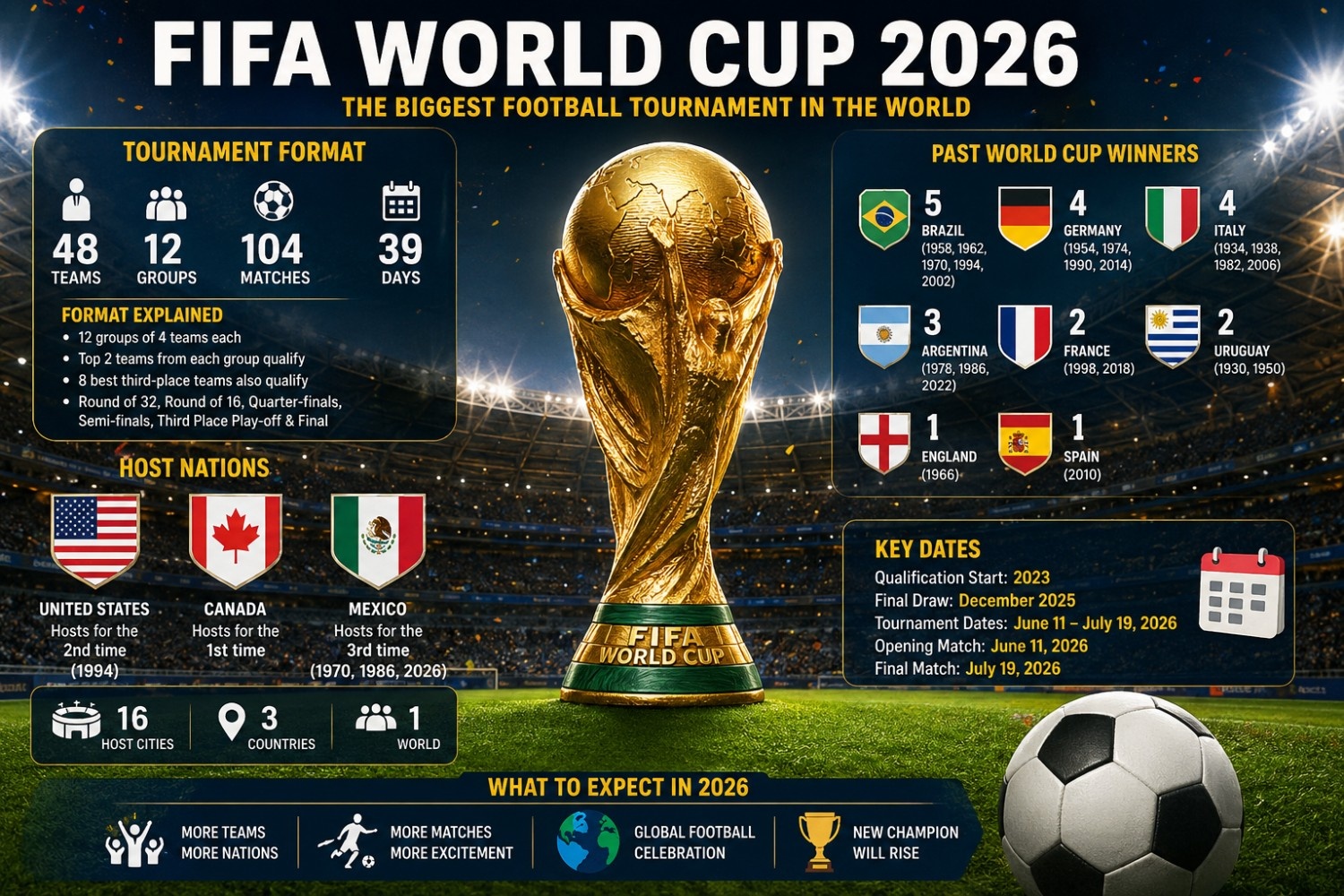
The FIFA World Cup 2026 is particularly significant because it introduces the largest tournament in history, featuring 48 national teams competing across the United States, Canada, and Mexico.
The History of the FIFA World Cup
The Birth of Football’s Biggest Competition
The first FIFA World Cup took place in 1930 in Uruguay.
Only 13 teams participated, with Uruguay defeating Argentina 4-2 in the final to become the inaugural world champions.
As football’s popularity exploded worldwide, the competition expanded dramatically over the following decades.
The tournament was suspended only twice—during 1942 and 1946—because of World War II. Since 1950, it has been held every four years, becoming one of the largest sporting events on Earth.
Today, the World Cup attracts billions of viewers from nearly every country around the globe.
Evolution of the Tournament
Throughout history, FIFA has continually expanded the competition.
1930
13 teams
1934–1978
16 teams
1982
24 teams
1998–2022
32 teams
FIFA World Cup 2026
48 teams
The expansion to 48 teams creates more opportunities for emerging football nations while increasing the number of matches and giving fans even more excitement throughout the tournament.
Why FIFA World Cup 2026 Is Historic
The FIFA World Cup 2026 introduces several historic milestones.
First World Cup Hosted by Three Nations
For the first time, three countries jointly host the tournament:
- United States
- Canada
- Mexico
Mexico also becomes the first nation to host three FIFA World Cups, after previously hosting the tournament in 1970 and 1986.
The United States returns as host after the successful 1994 World Cup, while Canada hosts matches for the first time.
Largest Tournament Ever
The tournament now features:
- 48 teams
- 12 groups
- 104 matches
- Nearly six weeks of football
This makes the FIFA World Cup 2026 the biggest edition ever organized.
How Teams Qualify
Qualification begins nearly three years before the finals.
Every continental confederation organizes qualification tournaments:
Europe (UEFA)
European nations compete through group qualification rounds and playoffs.
Traditional powerhouses such as England, France, Germany, Spain, Portugal, Italy, and the Netherlands regularly qualify through this pathway.
South America (CONMEBOL)
South American qualification is widely regarded as one of football’s toughest competitions.
Brazil, Argentina, Uruguay, Colombia, Ecuador, Paraguay, and others battle across an extended league format.
Africa (CAF)
African qualification continues to grow increasingly competitive.
Countries including Morocco, Senegal, Nigeria, Ghana, Egypt, Ivory Coast, Cameroon, and DR Congo compete for World Cup places.
Asia (AFC)
Asian football has improved dramatically over recent decades.
Japan, South Korea, Australia, Iran, Saudi Arabia, and several emerging nations compete through multiple qualification stages.
North America (Concacaf)
The United States, Canada, Mexico, Costa Rica, Panama, Jamaica, and other nations contest qualification.
Because the United States, Canada, and Mexico are hosts, they automatically qualify for the tournament.
Oceania (OFC)
Oceania now receives increased qualification opportunities thanks to FIFA’s expansion.
Tournament Format
The FIFA World Cup 2026 introduces an exciting new format.
Group Stage
- 48 teams
- 12 groups
- Four teams per group
Each nation plays three matches.
The top two teams from every group automatically qualify.
The eight best third-place teams also advance.
This creates a Round of 32 before progressing to the Round of 16.
Match Analysis: Why Every Game Matters
Unlike domestic leagues, every World Cup match carries enormous significance.
A single victory can transform a nation’s campaign, while one defeat can leave even the strongest teams facing elimination.
The expanded format means teams must balance attacking ambition with defensive discipline. Goal difference, head-to-head records, and overall consistency often determine qualification when teams finish level on points.
Fans can expect dramatic final group-stage matches, where simultaneous kickoffs increase suspense and every goal has the potential to reshape the standings.
Home Advantage
Host nations traditionally perform well.
Examples include:
- Uruguay (1930) – Champions
- England (1966) – Champions
- Argentina (1978) – Champions
- France (1998) – Champions
With matches spread across North America, the United States, Canada, and Mexico hope home support will provide a significant advantage during the FIFA World Cup 2026.
The Global Impact of the FIFA World Cup
Few sporting events rival the World Cup’s reach. Billions of viewers tune in from every continent, making it one of the most watched events in the world.
The tournament also delivers substantial economic benefits through tourism, broadcasting, sponsorships, and infrastructure development. Host cities welcome hundreds of thousands of international visitors, creating a festival atmosphere that extends beyond the stadiums.
For players, representing their country on football’s biggest stage is often considered the highest honor of their careers, adding emotion and intensity to every match.
Match Analysis: What Makes the FIFA World Cup Unique?
Every FIFA World Cup produces unforgettable moments because every match carries enormous significance. Unlike domestic league competitions, where teams have an entire season to recover from poor performances, the World Cup allows very little margin for error. One brilliant performance can inspire a nation, while one disappointing result can end a team’s dream.
The FIFA World Cup 2026 has raised the level of competition even further with an expanded 48-team format. More nations than ever before are competing on football’s biggest stage, increasing the chances of dramatic upsets and breakthrough performances.
Tactical Evolution
Modern World Cup football has become increasingly tactical. Teams now emphasize:
- High pressing and quick ball recovery
- Fast counterattacks
- Flexible formations
- Possession-based football
- Data-driven match preparation
- Defensive organization
Managers constantly adjust tactics depending on their opponents, making every knockout match a fascinating battle of strategy.
Legendary Player Performances
Throughout World Cup history, individual brilliance has often defined entire tournaments.
Pelé – The King of Football
Pelé remains the only player to win three FIFA World Cups (1958, 1962, and 1970). His extraordinary creativity, finishing ability, and leadership helped establish Brazil as the world’s dominant football nation.
Diego Maradona – Mexico 1986
Few players have dominated a tournament like Diego Maradona did in 1986. His vision, dribbling, and leadership inspired Argentina to the title, including his unforgettable solo goal against England in the quarter-finals.
Ronaldo Nazário – Redemption in 2002
After suffering heartbreak in the 1998 final, Ronaldo returned four years later to score eight goals and lead Brazil to its fifth World Cup title, earning the Golden Boot.
Zinedine Zidane – France’s Hero
Zinedine Zidane’s two headed goals in the 1998 final helped France claim its first-ever World Cup. His elegance and composure made him one of the greatest midfielders in tournament history.
Lionel Messi – The Perfect Ending
The 2022 FIFA World Cup completed Lionel Messi’s legendary career. He scored in every knockout round and inspired Argentina to its third world title after an unforgettable final against France.
His leadership, passing, creativity, and clutch performances cemented his place among football’s all-time greats.
Kylian Mbappé – The Modern Superstar
Kylian Mbappé announced himself to the world by helping France win the 2018 World Cup and followed it with a sensational hat-trick in the 2022 final. His speed, finishing, and composure make him one of the biggest stars entering the FIFA World Cup 2026.
Greatest FIFA World Cup Teams
Brazil
Brazil is the most successful nation in World Cup history.
Achievements include:
- Five World Cup titles
- Only nation to qualify for every tournament
- Home to legends such as Pelé, Garrincha, Romário, Ronaldo, Ronaldinho, Kaká, and Neymar
Brazil’s attacking style has influenced football around the globe.
Germany
Germany is known for consistency.
The nation has reached numerous semi-finals and finals, winning four World Cup titles through disciplined football, tactical excellence, and strong team chemistry.
Italy
Italy has won four World Cups thanks to its famous defensive organization, tactical intelligence, and world-class goalkeeping.
Argentina
Argentina has become one of football’s modern powerhouses.
World Cup titles:
- 1978
- 1986
- 2022
The country has produced legends including Diego Maradona and Lionel Messi, two players who defined generations.
France
France has emerged as one of the strongest teams of the 21st century, winning titles in 1998 and 2018 while consistently reaching the latter stages of major tournaments.
FIFA World Cup Team Records
Most World Cup Titles
| Nation | Titles |
|---|---|
| Brazil | 5 |
| Germany | 4 |
| Italy | 4 |
| Argentina | 3 |
| France | 2 |
| Uruguay | 2 |
| England | 1 |
| Spain | 1 |
Most Tournament Appearances
Brazil holds the remarkable distinction of participating in every FIFA World Cup since 1930, demonstrating unparalleled consistency on the international stage.
Germany, Italy, Argentina, and Mexico have also built proud records with frequent appearances.
Highest-Scoring Teams
Brazil and Germany have scored more World Cup goals than any other nations, reflecting decades of attacking excellence and deep tournament runs.
Historic Achievements
The FIFA World Cup has witnessed countless milestones that continue to define football history.
1958
Pelé became the youngest player ever to score in a World Cup final.
1966
England captured its first and only World Cup title on home soil.
1970
Brazil became the first nation to win three World Cups, earning permanent possession of the Jules Rimet Trophy.
1986
Diego Maradona produced one of the greatest individual tournament performances ever seen.
1998
France won its first World Cup as tournament host.
2010
Spain claimed its maiden World Cup title with its iconic possession-based style.
2014
Germany defeated Brazil 7–1 in the semi-final, one of the most astonishing results in World Cup history.
2022
Argentina lifted its third World Cup after an unforgettable final widely regarded as one of the greatest matches ever played.
Top World Cup Scorers
Some of football’s greatest goalscorers have left their mark on the tournament.
- Miroslav Klose – 16 goals
- Ronaldo – 15 goals
- Gerd Müller – 14 goals
- Just Fontaine – 13 goals
- Pelé – 12 goals
- Lionel Messi – 13 goals
- Kylian Mbappé – Already among the leading active scorers entering the FIFA World Cup 2026
Their achievements continue to inspire future generations.
Greatest FIFA World Cup Finals
Brazil vs Italy (1970)
Brazil’s 4–1 victory showcased perhaps the greatest team performance ever seen in a World Cup final.
Italy vs West Germany (1982)
Italy’s disciplined display earned a memorable 3–1 victory and a third world title.
France vs Brazil (1998)
France shocked defending champions Brazil 3–0 to win its first World Cup.
Germany vs Argentina (2014)
Mario Götze’s extra-time winner secured Germany’s fourth title after a tense and tactical contest.
Argentina vs France (2022)
Often described as one of the greatest finals in football history, the match featured dramatic momentum swings, a hat-trick from Kylian Mbappé, and Lionel Messi leading Argentina to victory after a penalty shootout.
FIFA World Cup Statistics
The tournament’s global popularity continues to grow with every edition.
- More than 80 national teams have appeared in World Cup finals.
- Billions of viewers watch each tournament worldwide.
- Hundreds of millions follow matches through digital platforms and social media.
- The FIFA World Cup is broadcast in more than 200 countries and territories.
The FIFA World Cup 2026 is expected to set new records for attendance, television audiences, and digital engagement due to its expanded format and North American hosting.
Memorable Moments Leading into FIFA World Cup 2026
The road to the FIFA World Cup 2026 has already produced several remarkable stories:
- Emerging football nations have qualified and challenged traditional powers.
- Established favorites continue to evolve with exciting young talent.
- Veteran players aim to make one final impact on football’s biggest stage.
- New tactical trends and advanced analytics are reshaping international football.
With 48 teams, 104 matches, and three host nations, the stage is set for one of the most exciting editions in the tournament’s history.