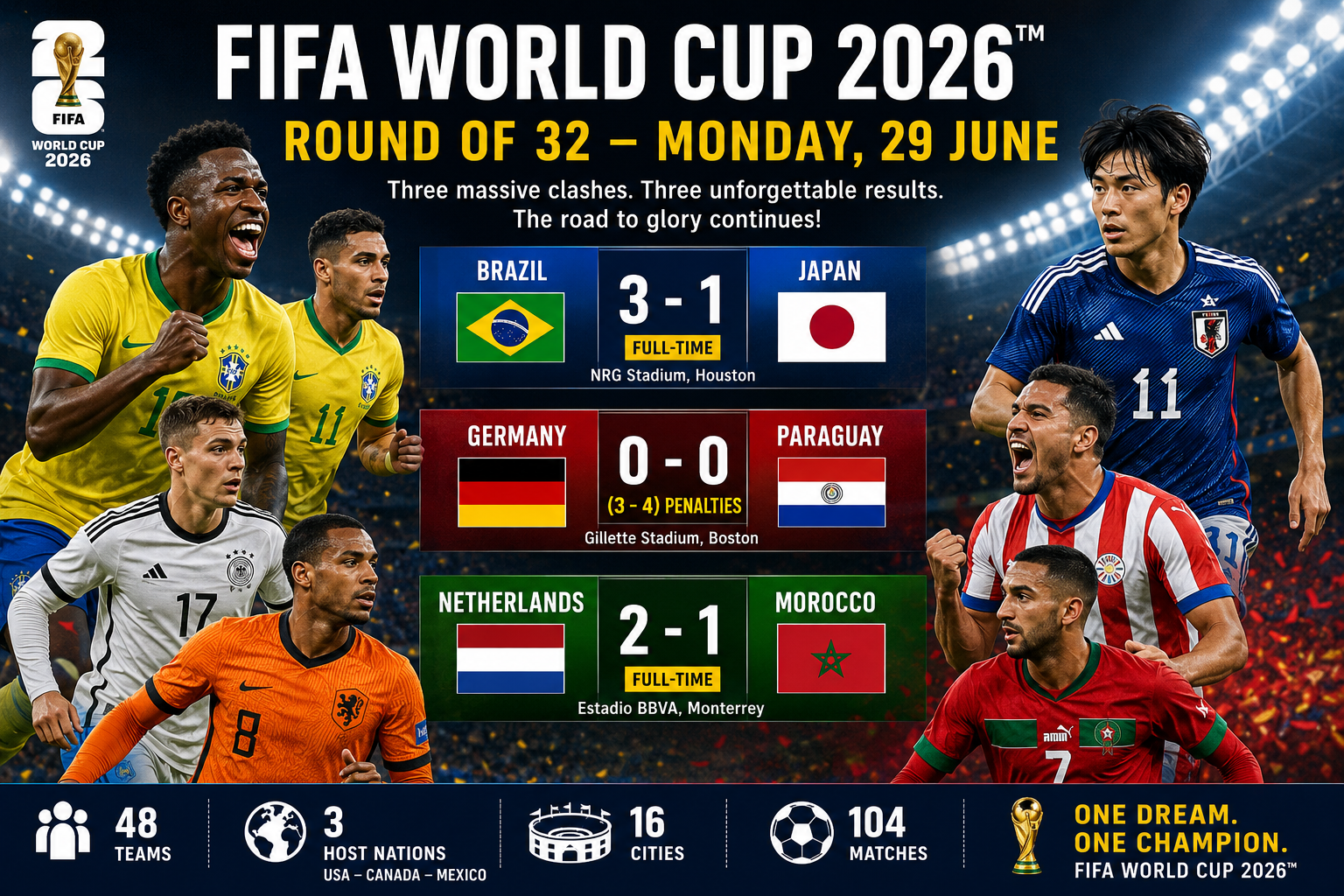
The FIFA World Cup 2026 Round of 32 continues with Brazil vs Japan, Germany vs Paraguay, and the Netherlands vs Morocco. Explore complete match previews, FIFA World Cup history, tournament format, star players, records, statistics, and knockout stage
fifa-world-cup-2026-round-of-32-brazil-japan-germany-paraguay-netherlands-morocco-preview
FIFA World Cup 2026 Round of 32: Football’s Biggest Tournament Enters a New Chapter
The FIFA World Cup 2026 has entered its most exciting phase as the knockout rounds begin across the United States, Canada, and Mexico. After an unforgettable group stage filled with dramatic upsets, emerging stars, and record-breaking performances, the Round of 32 now presents football fans with high-stakes encounters where every match becomes a win-or-go-home battle.
Monday’s schedule features three fascinating fixtures. Five-time world champions Brazil face a confident Japan side that has become one of Asia’s football powerhouses. Four-time champions Germany take on Paraguay, while the Netherlands meet Morocco in what promises to be one of the most evenly matched contests of the tournament.
These matches are about more than simply advancing to the next round. They represent opportunities to make history, extend legendary football traditions, and continue the pursuit of the most prestigious trophy in world football.
A Brief History of the FIFA World Cup
The FIFA World Cup was first held in 1930 in Uruguay, with the host nation lifting the inaugural trophy. Since then, the tournament has evolved into the world’s largest sporting event, watched by billions of fans across every continent.
Over nearly a century, the World Cup has produced unforgettable moments, iconic goals, legendary players, and emotional victories that have defined generations of football supporters.
Among the most successful nations are:
- Brazil – 5 World Cup titles
- Germany – 4 World Cup titles
- Italy – 4 World Cup titles
- Argentina – 3 World Cup titles
- France – 2 World Cup titles
- Uruguay – 2 World Cup titles
- England – 1 World Cup title
- Spain – 1 World Cup title
The competition has introduced football legends such as Pelé, Diego Maradona, Ronaldo Nazário, Zinedine Zidane, Ronaldinho, Lionel Messi, Cristiano Ronaldo, and many more whose performances became part of sporting history.
FIFA World Cup 2026: A Historic New Era
The FIFA World Cup 2026 marks the biggest expansion in tournament history.
For the first time:
- 48 national teams qualified.
- The tournament is hosted by three countries: the United States, Canada, and Mexico.
- More matches are played than ever before.
- More nations have the opportunity to compete on football’s biggest stage.
The expanded tournament reflects football’s growing popularity worldwide while giving emerging football nations a realistic opportunity to challenge traditional powers.
How Teams Qualified for FIFA World Cup 2026
Qualification began several years before the tournament, with every FIFA confederation receiving an increased number of qualification places because of the expansion to 48 teams.
Continental qualifying tournaments were held across:
- UEFA (Europe)
- CONMEBOL (South America)
- AFC (Asia)
- CAF (Africa)
- CONCACAF (North America, Central America, and the Caribbean)
- OFC (Oceania)
The qualification campaign featured thousands of matches and showcased the global reach of the sport, culminating in a diverse field of 48 teams representing every corner of the football world.
Understanding the 48-Team Tournament Format
The FIFA World Cup 2026 introduced a revised structure designed to balance competitiveness and opportunity.
The tournament began with 12 groups of four teams. Each nation played three group-stage matches, with teams earning:
- Three points for a win
- One point for a draw
- Zero points for a loss
The top two teams from each group, along with the eight best third-placed teams, advanced to the newly created Round of 32.
From this point onward, the tournament follows a straightforward knockout format:
- Round of 32
- Round of 16
- Quarter-finals
- Semi-finals
- Third-place playoff
- Final
Every knockout match must produce a winner, meaning extra time and penalty shootouts are used if scores remain level after 90 minutes.
Canada Makes History to Open the Knockout Stage
The Round of 32 began with a memorable achievement for Canada, who defeated South Africa 1–0 at Los Angeles Stadium.
Both nations had reached the FIFA World Cup knockout stage for the first time, making the occasion historic regardless of the outcome.
Canada’s disciplined defensive performance, tactical organization, and decisive finishing secured one of the biggest victories in the country’s football history and highlighted the increasing competitiveness of international football.
Brazil vs Japan: A Clash of Footballing Cultures
Venue: Houston
The headline match on Monday sees Brazil face Japan in a contest that blends tradition, flair, discipline, and tactical sophistication.
Brazil entered the knockout stage after topping Group C with victories over Haiti and Scotland before drawing against Morocco. Their performances confirmed why they remain among the tournament favorites.
Japan, meanwhile, impressed throughout the group stage. The Samurai Blue defeated Tunisia 4–0, earned an important draw against Sweden, and finished runners-up behind the Netherlands.
This fixture promises an intriguing contrast between Brazil’s attacking creativity and Japan’s disciplined, high-energy style of play.
Brazil’s Road to the Round of 32
Brazil showcased balance throughout the group stage. Their attacking players created numerous chances, while their defense remained compact under pressure.
Key strengths include:
- Quick wing play
- Creative midfield combinations
- High pressing
- Technical superiority in possession
- Clinical finishing in the final third
Brazil’s experience in major tournaments continues to be one of their greatest advantages, and they enter every knockout match with the expectation of competing for the title.
Brazil’s Star Players
Several world-class players have driven Brazil’s success so far:
- Vinícius Júnior has consistently threatened defenders with his pace and dribbling.
- Rodrygo has provided creativity and intelligent movement.
- Endrick continues to demonstrate why he is considered one of football’s brightest young talents.
- Bruno Guimarães controls the midfield with composure and vision.
- Marquinhos anchors the defense with leadership and experience.
Together, they form one of the tournament’s most balanced squads.
Japan Continues to Impress the World
Japan’s rise has been one of international football’s greatest success stories over the past two decades.
Known for tactical discipline, relentless work rate, and technical precision, the Samurai Blue have become consistent contenders on the global stage.
Players such as Takefusa Kubo, Kaoru Mitoma, and captain Wataru Endo have combined experience with creativity, making Japan capable of competing against any opponent.
Their confidence received a significant boost after defeating Brazil 3–2 in an international friendly before the tournament—their first-ever senior victory over the South American giants.
Tactical Preview
Brazil are expected to dominate possession, using their wide players to stretch Japan’s defense and create scoring opportunities through quick passing combinations.
Japan are likely to defend in a compact shape before launching rapid counterattacks through the pace of Mitoma and the creativity of Kubo.
If Japan can frustrate Brazil early and remain organized defensively, the pressure could shift onto the tournament favorites. Conversely, an early Brazilian goal may force Japan to open up, creating more opportunities for the Selecão.
The winner will advance to face either Côte d’Ivoire or Norway in the Round of 16, making this one of the most important fixtures of the knockout stage.
Germany vs Paraguay: One of the Biggest Upsets of FIFA World Cup 2026
Venue: Boston Stadium
If Brazil’s victory over Japan reinforced the status of a title contender, Germany’s clash with Paraguay delivered one of the tournament’s most dramatic surprises.
Germany entered the Round of 32 as overwhelming favorites. The four-time world champions had displayed impressive balance during the group stage, combining disciplined defending with creative midfield play. Their squad featured a blend of experienced leaders and rising stars, making them one of the strongest teams remaining in the FIFA World Cup 2026.
Paraguay, meanwhile, advanced as one of the best third-placed teams. Many analysts viewed them as underdogs, but they embraced that role with determination, organization, and belief.
Germany’s Tournament Journey
Germany reached the knockout stage after an impressive group campaign built around:
- Strong defensive organization
- Intelligent midfield control
- Clinical finishing
- Tactical flexibility
Young talents such as Jamal Musiala and Florian Wirtz added creativity, while experienced players helped maintain composure in crucial moments.
Paraguay’s Defensive Masterclass
Paraguay entered the match with a clear strategy:
- Stay compact defensively.
- Limit Germany’s attacking space.
- Capitalize on counterattacks and set pieces.
That disciplined approach frustrated Germany throughout regulation time. After a hard-fought contest finished level, Paraguay held their nerve in the penalty shootout to eliminate one of football’s traditional giants in one of the biggest shocks of the FIFA World Cup 2026.
Historical Perspective
Germany and Paraguay had previously met in the 2002 FIFA World Cup Round of 16, where Germany advanced on their way to the final.
More than two decades later, Paraguay rewrote history by claiming a famous knockout victory, creating one of the nation’s greatest World Cup moments.
Netherlands vs Morocco: Two Modern Football Powers Meet
Venue: Monterrey
The final match of Monday’s schedule featured two teams that have steadily established themselves among international football’s strongest competitors.
The Netherlands entered as Group F winners after an impressive unbeaten campaign built on attacking football and tactical discipline.
Morocco continued the momentum gained from recent international success, once again proving they belong among the world’s elite teams.
Netherlands’ Strengths
The Dutch combined technical excellence with physical intensity.
Key qualities included:
- Controlled possession
- Creative midfield play
- Dangerous wing attacks
- Defensive stability
- Excellent squad depth
Players such as Cody Gakpo, Xavi Simons, and captain Virgil van Dijk provided quality in every area of the pitch.
Morocco’s Confidence
Morocco continued to build on their growing international reputation.
Their disciplined defending, quick transitions, and fearless mentality made them one of the tournament’s most difficult teams to face.
Led by Achraf Hakimi, Sofyan Amrabat, and Youssef En-Nesyri, Morocco entered the knockout stage believing another deep World Cup run was possible.
Star Players to Watch
Brazil
Vinícius Júnior
Brazil’s explosive winger has consistently created scoring opportunities with pace, skill, and intelligent movement.
Rodrygo
Rodrygo’s versatility allows him to operate across the attacking line, making him one of Brazil’s most dangerous forwards.
Endrick
Still in the early stages of his international career, Endrick continues to demonstrate remarkable maturity and finishing ability.
Japan
Takefusa Kubo
Kubo remains Japan’s chief creative force, capable of unlocking defenses with precise passing and close control.
Kaoru Mitoma
Mitoma’s speed and direct running provide Japan with a constant counterattacking threat.
Wataru Endo
The experienced midfielder anchors Japan’s tactical structure through leadership and defensive intelligence.
Germany
Jamal Musiala
Musiala’s dribbling ability and creativity make him one of world football’s brightest young stars.
Florian Wirtz
Wirtz continues to develop into one of Europe’s elite playmakers through vision, passing, and composure.
Paraguay
Miguel Almirón
Almirón provides leadership, pace, and tireless work rate in attacking transitions.
Julio Enciso
Enciso’s creativity and confidence continue to make him one of South America’s most exciting young players.
Netherlands
Cody Gakpo
Gakpo combines finishing ability with intelligent movement, making him a consistent scoring threat.
Xavi Simons
Simons’ creativity and technical ability allow him to influence matches from midfield and attack.
Virgil van Dijk
The Dutch captain remains one of football’s most commanding central defenders.
Morocco
Achraf Hakimi
One of the world’s premier attacking full-backs, Hakimi contributes at both ends of the pitch.
Sofyan Amrabat
Amrabat controls midfield battles through intelligent positioning and physical presence.
Youssef En-Nesyri
En-Nesyri’s aerial ability and finishing make him Morocco’s primary goal-scoring threat.
FIFA World Cup Records
Some of the most remarkable achievements in FIFA World Cup history include:
- Brazil holds a record five FIFA World Cup titles.
- Germany has reached more World Cup semifinals than almost any other nation.
- Argentina are the defending world champions entering the 2026 tournament.
- The Netherlands have appeared in multiple World Cup finals despite never winning the trophy.
- Morocco became the first African nation to reach a World Cup semifinal in 2022, inspiring football across the continent.
FIFA World Cup Statistics
The expanded FIFA World Cup 2026 has already produced several notable trends:
- 48 national teams competing for the first time.
- A new Round of 32 has increased the number of knockout fixtures.
- More goals have been scored during the expanded tournament.
- Emerging football nations continue to challenge traditional powers.
- Record attendances across the United States, Canada, and Mexico have highlighted football’s growing popularity in North America.
Knockout Stage Preview
With Brazil advancing and Paraguay producing a memorable upset over Germany, the knockout bracket has become even more unpredictable. Every remaining team now stands just a few victories away from football’s greatest prize, ensuring that every match carries enormous pressure and excitement.
Historical Achievements That Define the FIFA World Cup
Few sporting events carry the prestige and emotional significance of the FIFA World Cup. Since its inaugural edition in 1930, the tournament has produced countless unforgettable moments that continue to inspire football fans around the globe.
Brazil remain the most successful nation in World Cup history with five titles, while Germany and Italy have each won four championships. Argentina added a third title in 2022, France have claimed two, and Uruguay, England, and Spain have each lifted the famous trophy once.
The tournament has also been the stage where football legends cemented their legacies. Pelé became the youngest World Cup winner at just 17 years old in 1958, Diego Maradona delivered one of the greatest individual performances in 1986, Zinedine Zidane inspired France to their first title in 1998, and Lionel Messi completed his extraordinary career by leading Argentina to the championship in 2022.
The FIFA World Cup has continually evolved, producing iconic goals, dramatic penalty shootouts, and emotional underdog stories that have become part of football history.
Why FIFA World Cup 2026 Is Unlike Any Previous Tournament
The FIFA World Cup 2026 represents a historic turning point for international football.
For the first time, the tournament features:
- 48 participating nations.
- Three host countries: the United States, Canada, and Mexico.
- An expanded Round of 32 knockout stage.
- More matches than any previous FIFA World Cup.
- Greater opportunities for emerging football nations to compete on the world’s biggest stage.
The expanded format has already delivered more competitive matches, surprise results, and memorable performances, demonstrating the growing strength of football across every continent.
The United States Takes Center Stage
For American football fans, the FIFA World Cup 2026 is particularly significant.
The United States is hosting the majority of tournament matches in world-class venues across cities including New York/New Jersey, Los Angeles, Houston, Miami, Seattle, Dallas, Atlanta, Boston, Kansas City, Philadelphia, and San Francisco.
The competition has generated record attendances, massive television audiences, and unprecedented interest in soccer across the country. Youth participation, media coverage, and fan engagement continue to grow as millions of Americans experience the excitement of the FIFA World Cup firsthand.
The successful staging of matches has further strengthened the United States’ reputation as one of the world’s premier hosts for major sporting events.
What to Expect in the Knockout Stage
With every passing round, the margin for error becomes even smaller.
Brazil continue to demonstrate why they are among the favorites to win a sixth World Cup title, combining attacking flair with defensive stability.
Paraguay’s stunning elimination of Germany serves as a reminder that no team can be taken lightly. The expanded tournament has created more opportunities for emerging nations to challenge traditional powers, making every knockout fixture unpredictable.
The Netherlands and Morocco also remain determined to continue their impressive campaigns, while several other contenders are preparing for equally demanding Round of 16 encounters.
As the bracket narrows, every match becomes an opportunity to create history, with players aiming to deliver performances that will be remembered for generations.
Key FIFA World Cup 2026 Statistics
- Tournament edition: 23rd FIFA World Cup
- Host nations: United States, Canada, and Mexico
- Participating teams: 48
- Groups: 12
- Knockout stage begins with the Round of 32
- More than 100 matches scheduled across the tournament
- Largest FIFA World Cup in history
- First World Cup hosted by three nations
These milestones highlight how the FIFA World Cup 2026 is redefining the scale of international football while maintaining the drama and prestige that have made the competition the sport’s greatest event.
Frequently Asked Questions
Why is the FIFA World Cup 2026 different?
It is the first World Cup to feature 48 teams, three host nations, and an expanded Round of 32 knockout stage.
Who are the favorites to win the FIFA World Cup 2026?
Traditional contenders such as Brazil, Argentina, England, France, Spain, and the Netherlands entered the knockout stage among the leading favorites, while surprise teams continue to challenge expectations.
How many teams qualified for the knockout stage?
Thirty-two teams advanced from the group stage, including the top two teams from each group and the eight best third-placed teams.
Why has the tournament attracted so much attention in the United States?
Hosting the majority of matches has brought world-class football to American stadiums, increasing fan engagement, television audiences, and overall interest in the sport across the country.
Conclusion
The FIFA World Cup 2026 has entered its defining stage, where every match has the potential to reshape the tournament.
Brazil’s pursuit of a record-extending sixth title, Paraguay’s memorable upset over Germany, and the high-quality contest between the Netherlands and Morocco illustrate why the knockout rounds captivate football fans around the world.
With the expanded 48-team format delivering greater competitiveness, more emerging nations making history, and passionate crowds filling stadiums across North America, this tournament is already establishing itself as one of the most memorable editions in FIFA World Cup history.
As the journey toward the final continues, supporters can expect more spectacular goals, tactical masterclasses, dramatic penalty shootouts, and unforgettable moments that define the magic of the FIFA World Cup. Whether powerhouse nations add to their legacy or new contenders rise to prominence, the FIFA World Cup 2026 continues to prove why it remains the pinnacle of international football.